Introduction: A New Era of Personalised Healthcare
The medical industry is undergoing a major transformation driven by the need for faster innovation, patient-specific treatments, and high-performance materials. Traditional manufacturing methods often fail to deliver complex geometries, lightweight structures, and personalised implants that modern medicine requires.
Metal 3D printing—particularly Laser Powder Bed Fusion (LPBF)—has emerged as a breakthrough technology that enables full customisation of medical components with exceptional precision, repeatability, and material quality. Companies like E-Metal3D, supported by EPlus3D systems, are helping medical manufacturers across Australia push the boundaries of what is possible.
Why Customisation Matters in Modern Medicine
Medical conditions are rarely the same from one patient to another. Anatomical structures vary in size, curvature, bone density, and biological compatibility. Customisation helps solve critical medical challenges:
-
Better anatomical fit
-
Reduced recovery time
-
Improved implant longevity
-
Enhanced biocompatibility
-
Reduced surgical risks
Metal 3D printing enables surgeons and biomedical engineers to design implants that match a patient’s anatomy with near-perfect accuracy—something that is extremely difficult with conventional machining or casting.
The Role of Metal 3D Printing in Personalised Medical Components
1. Patient-Specific Implants (PSI)
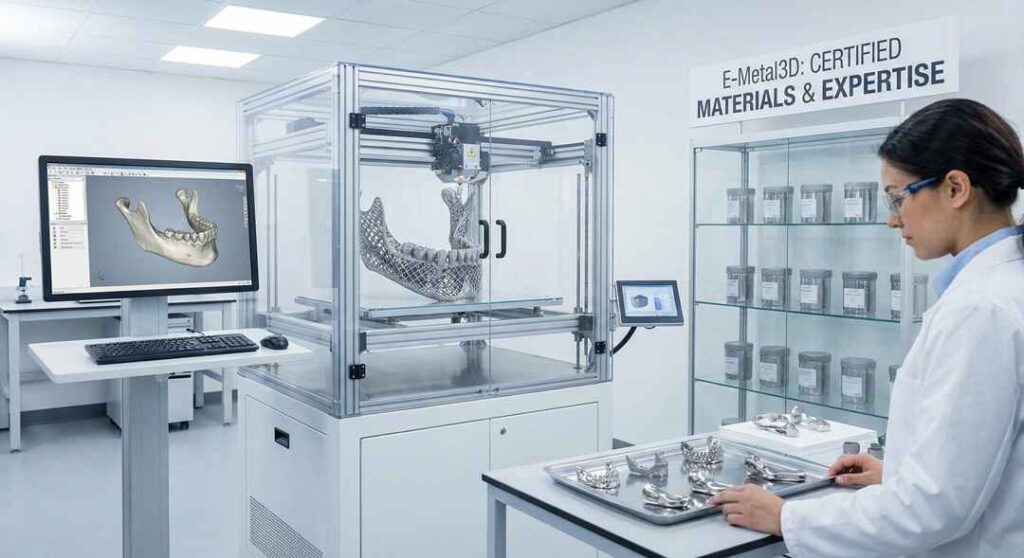
With CT or MRI scans, medical teams can generate a precise 3D model of a patient’s anatomy. LPBF machines can then manufacture customised implants such as:
-
Titanium cranial plates
-
Mandibular or facial reconstruction implants
-
Hip cups and acetabular components
-
Spinal cages
Why LPBF is ideal:
-
Allows highly complex lattice structures
-
Produces near-net-shape parts with minimal machining
-
Offers outstanding mechanical strength with medical-grade materials
E-Metal3D supports hospitals and engineering firms by offering design validation, topology optimisation, and high-precision manufacturing using certified titanium powders.
2. Complex Geometries for Better Biological Performance
Customisation is not just about external shape—it also includes internal structures.
LPBF enables engineers to create:
-
Porous surfaces that improve osseointegration
-
Lightweight frameworks with internal channels
-
Lattices that mimic real bone structure
These features dramatically enhance implant stability and long-term biocompatibility.
3. Customised Surgical Tools and Guides
Metal 3D printing allows rapid production of:
-
Personalised surgical cutting guides
-
Fixation plates
-
Orthopaedic jigs
-
Sterile-ready custom tools
These tools reduce surgical time, improve accuracy, and minimise the margin of error—especially in complex operations such as reconstructive surgery or joint replacement.
4. Rapid Prototyping for Faster Medical Device Innovation
Medical device manufacturers must constantly iterate designs for performance, regulatory compliance, and clinical trials.
Metal AM accelerates this process by enabling:
-
Rapid iteration
-
On-demand modifications
-
Full functional testing
-
Reduced tooling costs
With E-Metal3D’s engineering team and EPlus3D LPBF systems, prototypes can be printed in days rather than months.
5. Material Advantages for Medical Applications
The most commonly used metal in medical AM is Ti6Al4V ELI, chosen for its:
-
High biocompatibility
-
Superior strength-to-weight ratio
-
Corrosion resistance
-
Compatibility with human bone
E-Metal3D provides certified, medical-grade metal powders that meet ISO and ASTM standards, ensuring consistent mechanical performance.
How the Customisation Workflow Happens
Here is the typical workflow E-Metal3D supports for medical partners:
Step 1: Anatomical Scanning
Using CT or MRI imaging, detailed patient anatomy is digitised.
Step 2: CAD Modelling and Engineering Review
Designers create a PSI using biomedical engineering principles.
Step 3: Simulation & Topology Optimisation
The component is optimised for stress distribution, porosity, and weight.
Step 4: LPBF Printing
EPlus3D printers manufacture the implant with micron-level precision.
Step 5: Post-Processing
Includes heat treatment, machining, polishing, and quality inspection.
Step 6: Certification & Delivery
The product is validated for medical use and delivered to surgeons.
Real-World Medical Applications
Orthopaedic Implants
Custom hip implants, knee components, and spinal cages designed for patient-specific fit.
Cranial & Maxillofacial Reconstruction
LPBF enables organic shapes with detailed anatomical accuracy, essential after trauma or tumour removal.
Dental Implants
Custom abutments, bridges, and surgical guides that match jaw geometry.
Custom Surgical Equipment
Sterile, lightweight, ergonomic tools for specialised procedures.
Benefits of Customised Metal Medical Components
Clinical Benefits
-
Faster surgery time
-
Better implant stability
-
Lower rejection rates
-
Improved patient comfort
Manufacturer Benefits
-
Zero tooling
-
Reduced production cost for complex parts
-
Faster R&D cycle
-
More design freedom
Industry-Wide Impact
Metal AM is becoming essential for modern healthcare.
Australia is rapidly adopting this technology, and E-Metal3D is at the forefront with EPlus3D systems and engineering expertise.
Challenges and Considerations
Even with its advantages, custom metal AM in medicine requires attention to:
-
Certification and regulatory compliance
-
Surface finishing for medical-grade products
-
Quality assurance and repeatability
-
Material traceability
E-Metal3D supports partners through each stage, ensuring compliance with medical standards and consistency across production batches.
Conclusion: The Future of Personalised Medicine
Metal 3D printing is no longer an emerging technology—it is becoming a core manufacturing method for medical customisation. From implants to surgical guides, LPBF provides the precision, material strength, and design freedom necessary to advance modern healthcare.
With over 20 years of engineering expertise, E-Metal3D is committed to helping Australian medical manufacturers innovate, customise, and deliver life-changing solutions using advanced metal AM technologies.