Introduction
The aerospace industry has always been at the forefront of technological innovation, pushing the boundaries of engineering, performance, and safety. As global demand for lighter, stronger, and more efficient aircraft grows, traditional manufacturing methods are no longer able to keep pace with the sector’s evolving requirements.
Metal Additive Manufacturing (Metal AM), particularly Laser Powder Bed Fusion (LPBF), has emerged as one of the most disruptive technologies reshaping aerospace engineering. Companies like Airbus and Boeing have embraced metal 3D printing not just for prototyping, but for full-scale production of aircraft components, unlocking new opportunities in weight reduction, design freedom, and supply chain efficiency.
This article explores how metal 3D printing is transforming aerospace manufacturing, with a deep dive into the latest real-world applications implemented by Airbus and Boeing.
1. The Need for Transformation in Aerospace Manufacturing
Aerospace components operate under extreme conditions—intense heat, stress, vibration, and environmental exposure. Traditionally, manufacturing these parts required complex machining, multi-step assembly processes, and significant material waste due to the subtractive nature of production.
Key challenges of traditional aerospace manufacturing:
-
High production costs for complex geometries
-
Long lead times for critical components
-
Difficulty optimizing internal structures
-
High material waste (especially titanium and nickel alloys)
-
Limited ability to innovate new designs due to tooling constraints
Metal 3D printing directly addresses these limitations by enabling engineers to create lightweight, high-strength parts that were previously impossible or uneconomical to produce.
2. Why Metal 3D Printing Is Ideal for Aerospace
2.1 Weight Reduction and Fuel Efficiency
Reducing even a few kilograms from an aircraft can save millions of dollars in fuel over its lifetime.
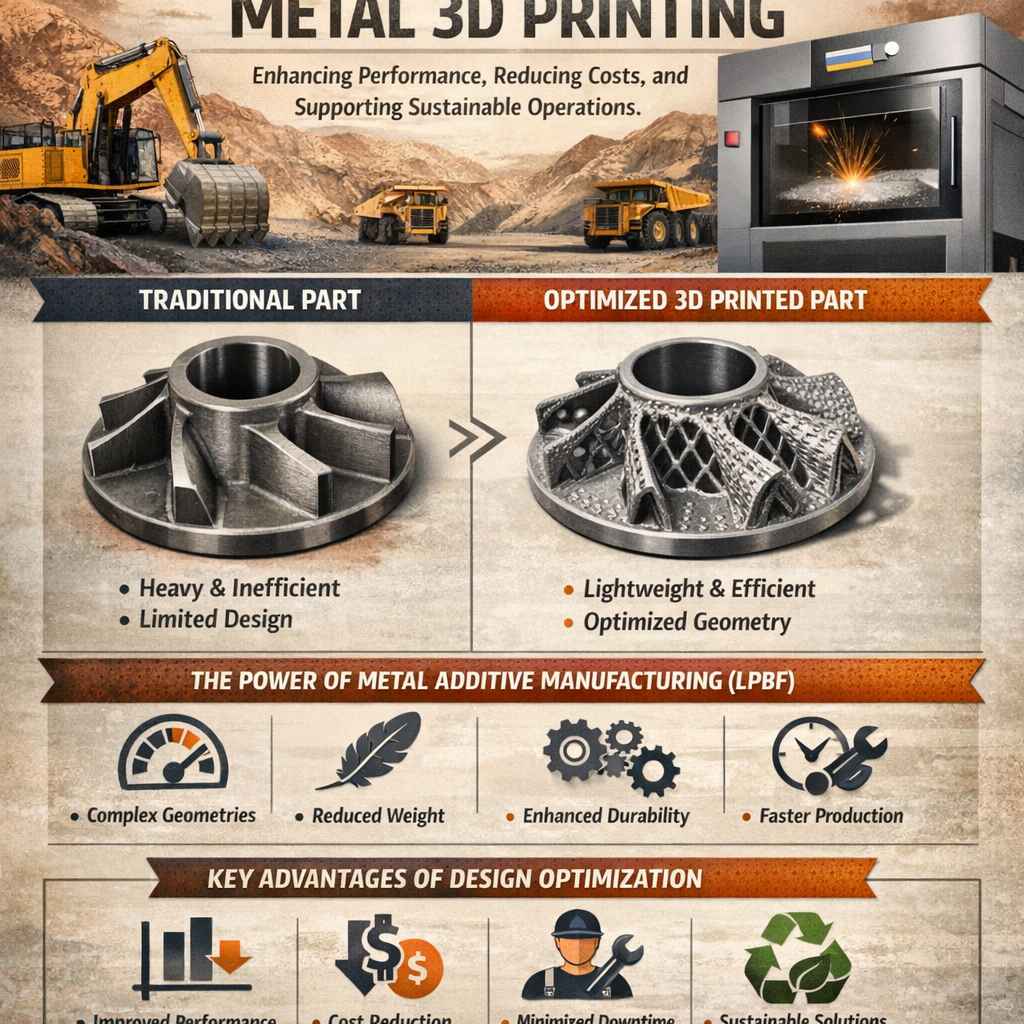
Metal 3D printing allows engineers to design lattice structures, hollow geometries, and topology-optimized components that maintain mechanical strength while reducing mass.
2.2 Improved Performance with Complex Geometries
LPBF enables internal channels, cooling pathways, and geometries that cannot be machined conventionally.
This leads to:
-
Improved thermal management
-
Higher engine efficiency
-
Longer component lifespan
2.3 Rapid Prototyping and Agile Design
Design cycles that once took months can now be completed in days.
This accelerates innovation and helps aerospace companies meet certification and testing milestones much faster.
2.4 Supply Chain Simplification
A single 3D printer can replace entire sets of tooling, casting, and machining steps.
This reduces dependence on long global supply chains—an advantage highlighted during the COVID-19 disruptions.
3. How Airbus Uses Metal 3D Printing
Airbus is one of the global leaders in adopting metal AM for commercial aircraft. They’ve integrated 3D printing into both production and R&D processes.
3.1 A350 XWB Titanium Brackets
One of Airbus’s landmark projects involved installing 3D-printed titanium brackets on the A350 XWB.
These parts reduced weight while maintaining structural integrity, demonstrating the feasibility of AM for flight-critical components.
3.2 Cabin and Structural Components
Airbus has produced over 1,000 3D-printed parts for the A350, including:
-
Structural supports
-
Cabin brackets
-
Sensor housings
-
Air duct components
These parts offer weight savings and improved performance.
3.3 The “Bionic Partition”
The Bionic Partition is a cabin divider redesigned using generative design and manufactured via metal 3D printing.
The result?
-
45% lighter than its conventional counterpart
-
Improved strength-to-weight ratio
-
Better energy absorption in crash scenarios
3.4 Metal AM Adoption for Space Division
Airbus Defence and Space uses LPBF to produce satellite brackets, antenna components and propulsion system parts, enabling lightweight designs that reduce launch costs.
4. How Boeing Uses Metal 3D Printing
Boeing has integrated metal AM into both aircraft manufacturing and defense applications.
4.1 Structural Titanium Parts for the 787 Dreamliner
Boeing implemented metal 3D-printed titanium components through certified AM suppliers, resulting in:
-
Lower material costs
-
Consistent quality
-
Shorter lead times
This demonstrated how AM could replace expensive forged titanium parts in real aircraft production.
4.2 Fuel Nozzles and Engine Components
Boeing’s collaboration with GE Aviation led to the creation of the famous 3D-printed fuel nozzle used in the LEAP engine.
Key benefits:
-
25% weight reduction
-
5× longer durability
-
One-piece design replacing 20 assembled parts
4.3 Defense Applications
Boeing utilizes metal AM for:
-
UAV components
-
Satellite structures
-
Thermal management parts
-
Fighter jet brackets
The ability to rapidly customize parts makes AM perfect for defense missions where speed and adaptability are essential.
4.4 Spacecraft Components
Boeing has tested 3D-printed metal propulsion valves and thruster components, showing high performance under extreme pressure and temperature variations.
5. Impact of Metal 3D Printing on Aerospace Engineering
5.1 Enhanced Safety and Reliability
LPBF produces dense, high-performance parts with properties equal to or better than forged components.
5.2 Lower Costs
Airbus and Boeing have reported measurable cost reductions due to:
-
Material savings
-
Fewer assembly steps
-
Streamlined logistics
5.3 Faster Certification Cycles
Digital workflows accelerate testing, iteration, and compliance with aviation standards like:
-
EASA
-
FAA
-
AS9100
5.4 Sustainability Benefits
-
Less material waste
-
Lower carbon footprint
-
Longer part lifecycle
Metal 3D printing supports global efforts toward greener aviation.
6. The Future of Metal 3D Printing in Aerospace
Automation and Industry 4.0 Integration
AI-driven quality control and predictive modeling are already improving consistency.
Larger Build Volumes
Next-generation LPBF machines are enabling larger aerospace structures.
New Alloys Designed for AM
Airbus and Boeing are testing:
-
Scalmalloy
-
Nickel-superalloy formulations
-
Titanium AM-specific blends
In-flight and On-demand Manufacturing
Long-term vision includes producing spare parts at airports or even in orbit for spacecraft.
Conclusion
Metal 3D printing is not just enhancing aerospace manufacturing—it is fundamentally redefining it. Airbus and Boeing are demonstrating that LPBF can deliver lighter, stronger, more efficient components while reducing production costs and accelerating development cycles.
As the technology matures, metal AM will play an increasingly central role in the future of aviation, from commercial aircraft and satellites to engines and defense systems. Companies that adopt this technology today are positioning themselves at the forefront of next-generation aerospace engineering.