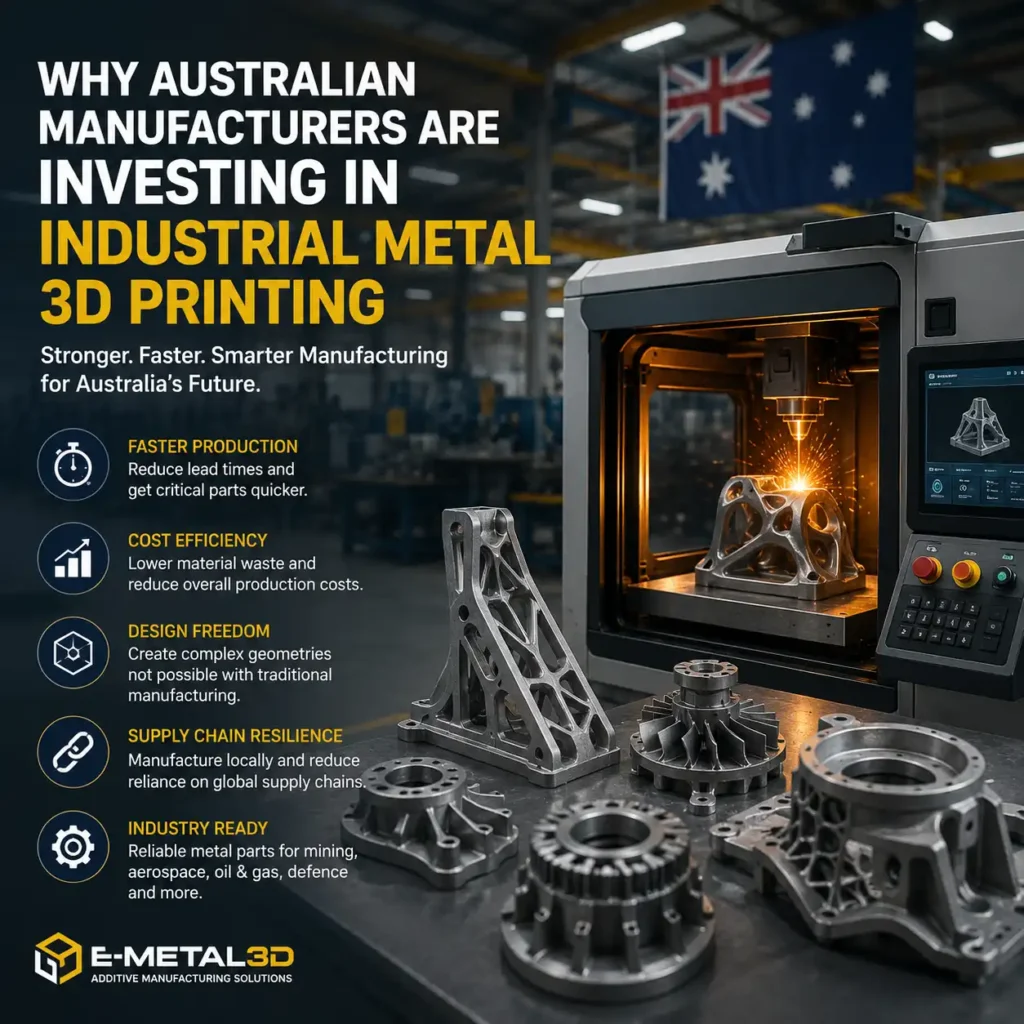
Manufacturing Is Changing Faster Than Ever
Australian manufacturers are facing increasing pressure to produce high-quality components while reducing lead times, lowering production costs, and improving supply chain resilience. Traditional manufacturing methods remain essential, but they are not always the most efficient solution—especially for complex, customised, or low-volume components.
This is why Metal 3D Printing has become one of the fastest-growing manufacturing technologies across industries including mining, aerospace, oil & gas, defence, medical, and industrial engineering.
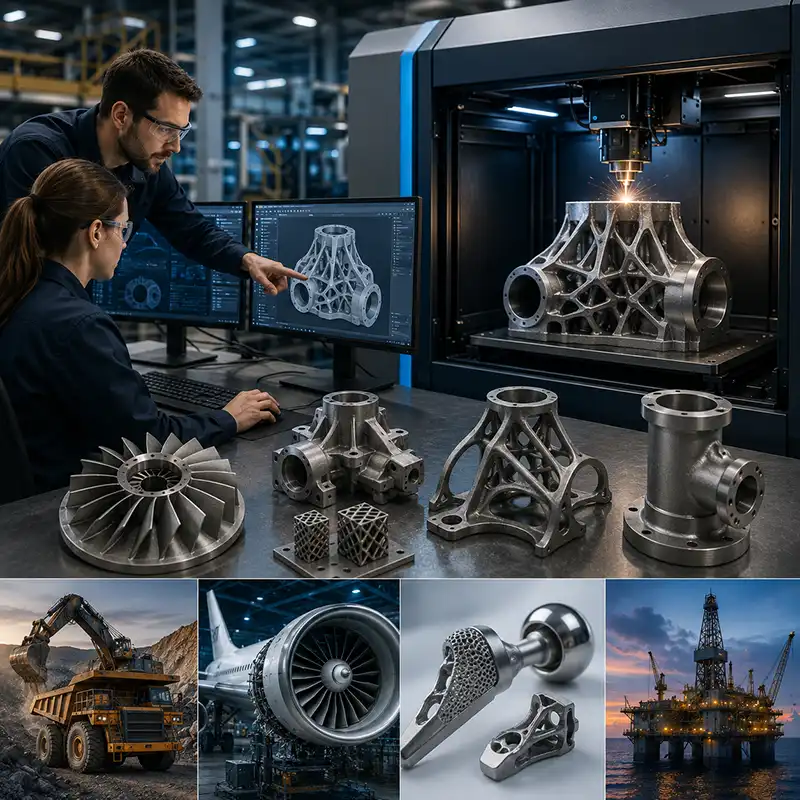
Unlike conventional manufacturing, metal additive manufacturing builds components layer by layer directly from a digital CAD model. This enables engineers to produce complex geometries, lightweight structures, and high-performance metal parts that would be difficult—or even impossible—to manufacture using traditional methods.
For businesses looking to improve productivity while reducing manufacturing constraints, Metal 3D Printing offers a practical engineering solution rather than simply another production technology.
Why Australian Industries Are Adopting Metal 3D Printing
Manufacturing priorities have changed significantly over the past decade.
Companies are no longer focused only on reducing production costs. They also need shorter lead times, greater design flexibility, and more reliable supply chains.
Metal 3D Printing addresses these challenges by allowing manufacturers to produce components on demand, eliminate unnecessary tooling, and accelerate product development.
Instead of waiting weeks or months for specialised parts, engineers can move directly from a validated digital model to production.
For industries operating in remote regions of Australia, this capability can significantly reduce downtime and improve operational continuity.
More Design Freedom Than Traditional Manufacturing
Conventional manufacturing often forces engineers to design around production limitations.
Casting requires moulds.
Machining requires tool access.
Fabrication increases assembly complexity.
Metal additive manufacturing removes many of these restrictions.
Engineers can design internal cooling channels, lightweight lattice structures, complex organic geometries, and consolidated assemblies without being constrained by traditional manufacturing processes.
Rather than asking, “Can we manufacture this?”, engineers can instead ask, “What is the best design for the application?”
That shift creates entirely new opportunities for innovation.
Faster Product Development
Developing industrial components traditionally involves multiple production stages before testing can begin.
Design changes often require new tooling, additional machining, and repeated manufacturing cycles.
Metal 3D Printing dramatically shortens this process.
Once a design has been validated, functional metal prototypes can be manufactured quickly, evaluated under real operating conditions, and refined before full production.
This faster development cycle helps businesses:
- Validate designs earlier
- Reduce engineering revisions
- Lower development costs
- Accelerate product launches
- Improve final product performance
For organisations competing in fast-moving industries, reducing development time can provide a significant commercial advantage.
Solving Supply Chain Challenges
Recent global supply chain disruptions highlighted how vulnerable many manufacturers have become.
Long shipping delays, limited inventory, and discontinued products have encouraged businesses to rethink how replacement components are sourced.
Instead of depending entirely on overseas suppliers, companies are increasingly adopting digital manufacturing strategies.
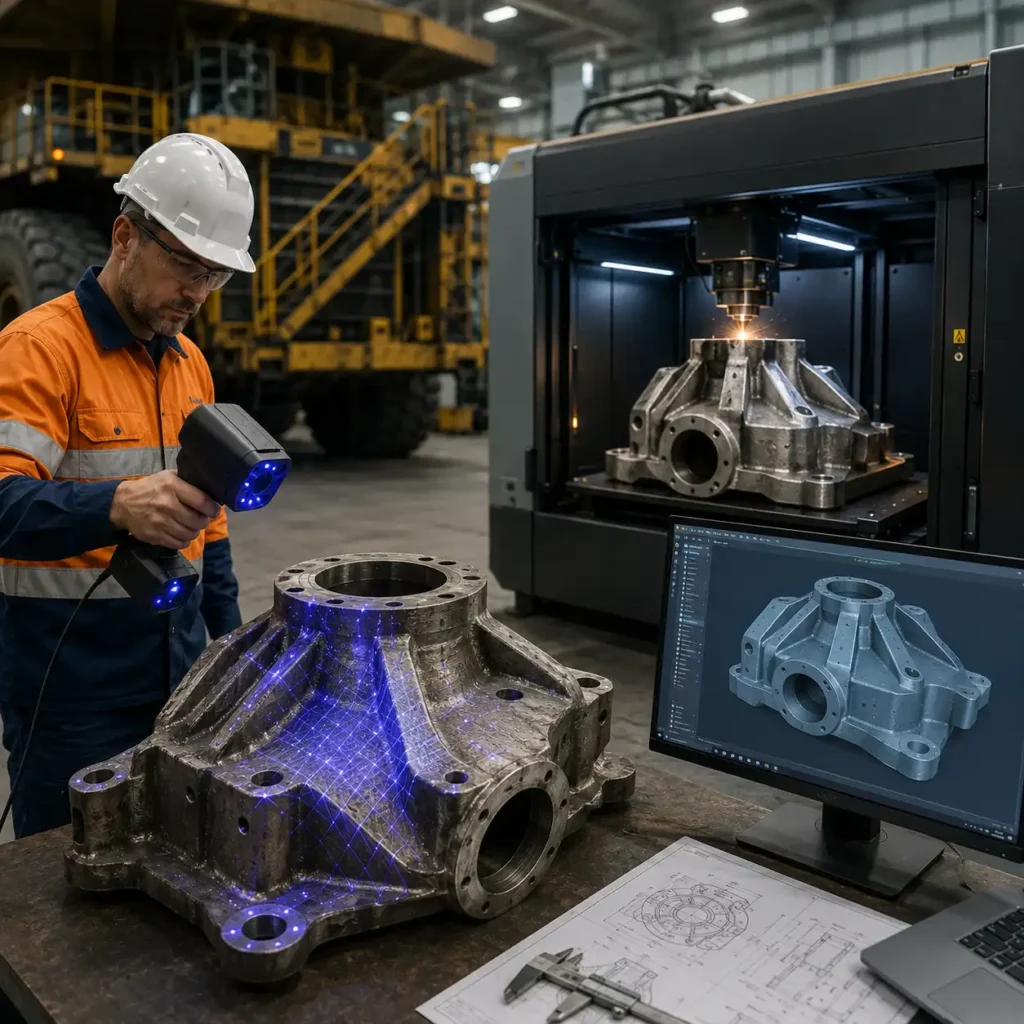
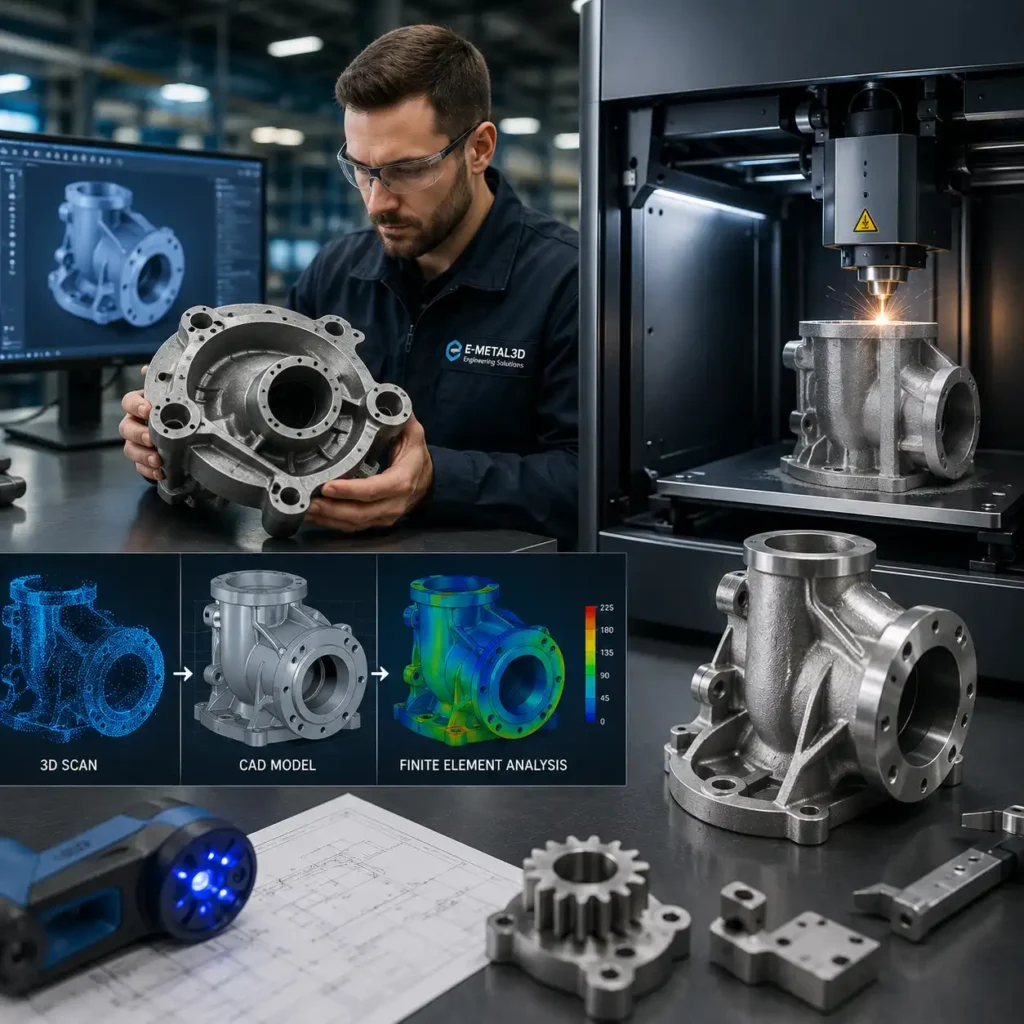
Using Engineering Solutions, 3D Scanning Services, and Metal 3D Printing, replacement parts can often be recreated locally from existing components—even when original CAD files no longer exist.
This approach provides greater manufacturing flexibility while reducing dependence on traditional supply chains.
Supporting Spare Parts Manufacturing
One of the most valuable applications of Metal 3D Printing is producing replacement components on demand.
Rather than maintaining expensive inventories of rarely used parts, businesses can manufacture components only when required.
This approach is particularly valuable for:
- Low-volume production
- Custom industrial components
- Legacy machinery
- Obsolete equipment
- Emergency replacement parts
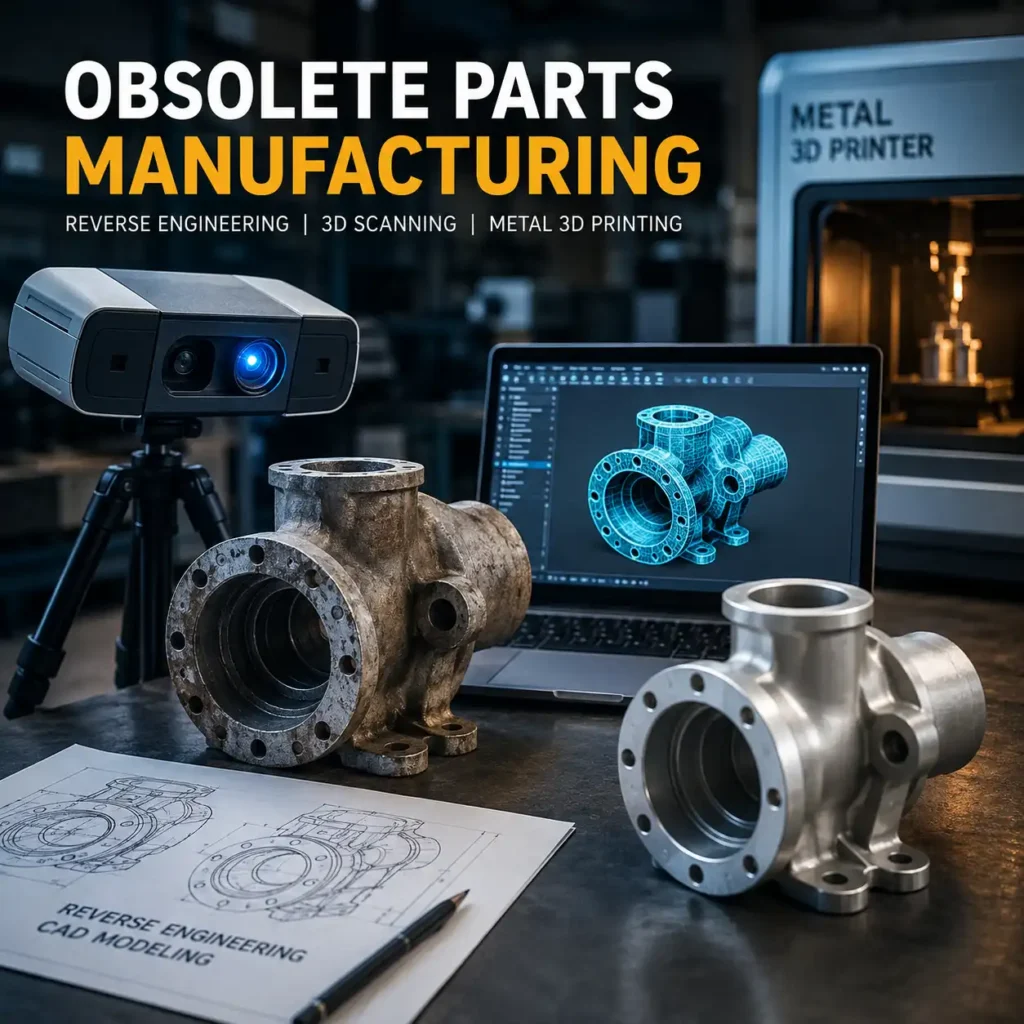
When combined with reverse engineering, even discontinued components can be reproduced with exceptional accuracy.
For many organisations, digital inventories are gradually replacing physical warehouses.
Engineering Before Manufacturing
Successful additive manufacturing starts long before the printer begins building a component.
Every project should first evaluate geometry, material selection, structural performance, manufacturing feasibility, and production objectives.
This is why Engineering Solutions play a critical role in modern additive manufacturing.
Using Design for Additive Manufacturing (DfAM), topology optimisation, simulation, and engineering analysis, components can be redesigned specifically for Metal 3D Printing.
The result is often a lighter, stronger, and more efficient component than the original design.
Industries Driving Adoption
Mining
The Mining Industry uses Metal 3D Printing to reduce equipment downtime, manufacture replacement wear components, and improve maintenance strategies for remote operations.
Manufacturing
Across the Manufacturing Industry, additive manufacturing supports rapid prototyping, production tooling, custom fixtures, and low-volume production without expensive tooling investments.
Oil & Gas
The Oil & Gas Industry benefits from high-performance metal components capable of operating under demanding temperatures, pressure, and corrosive environments.
Medical
Medical manufacturers use Metal 3D Printing to produce customised implants, surgical instruments, and patient-specific devices with exceptional precision.
The Future Is Digital Manufacturing
Manufacturing is no longer defined solely by machines on a factory floor.
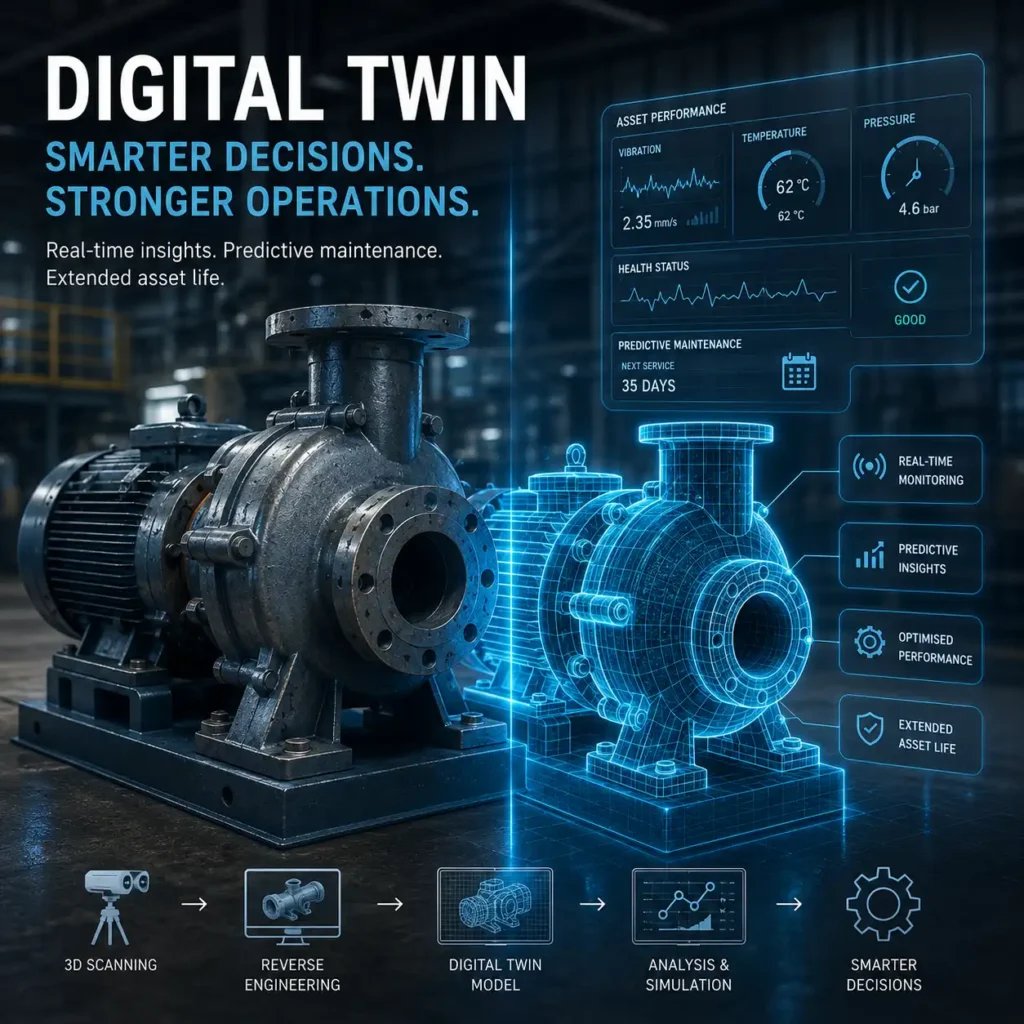
It is increasingly driven by digital engineering, intelligent design, and flexible production technologies.
Businesses that invest in digital manufacturing today gain more than faster production—they gain greater resilience, improved innovation, and stronger long-term competitiveness.
Metal 3D Printing is no longer an emerging technology.
It has become an essential manufacturing capability for organisations seeking to modernise production and respond more effectively to changing market demands.
Why Choose E-Metal3D?
At E-Metal3D, we combine advanced Metal 3D Printing, Engineering Solutions, and 3D Scanning Services to help Australian industries solve complex manufacturing challenges.
From rapid prototyping and reverse engineering to production-ready metal components, our engineering team delivers practical solutions that improve performance, reduce lead times, and support long-term manufacturing success.
Whether you need a single replacement component or a complete additive manufacturing strategy, E-Metal3D provides the engineering expertise and industrial experience to help your business move forward.
What industries use Metal 3D Printing?
Metal 3D Printing is widely used across mining, manufacturing, aerospace, defence, medical, automotive, and oil & gas industries for prototyping and production applications.
Is Metal 3D Printing suitable for production parts?
Yes. Modern industrial metal 3D printers produce high-performance components suitable for functional prototypes, low-volume production, and many end-use applications.
Can existing parts be reproduced using Metal 3D Printing?
Yes. Existing components can be recreated using 3D scanning and reverse engineering before being manufactured using Metal 3D Printing.