The medical industry thrives on innovation, precision, and reliability. Every new medical device or implant must undergo rigorous design, testing, and regulatory approvals before reaching patients. Traditional prototyping methods — including machining, casting, and molding — are often time-consuming, expensive, and limited in design flexibility.
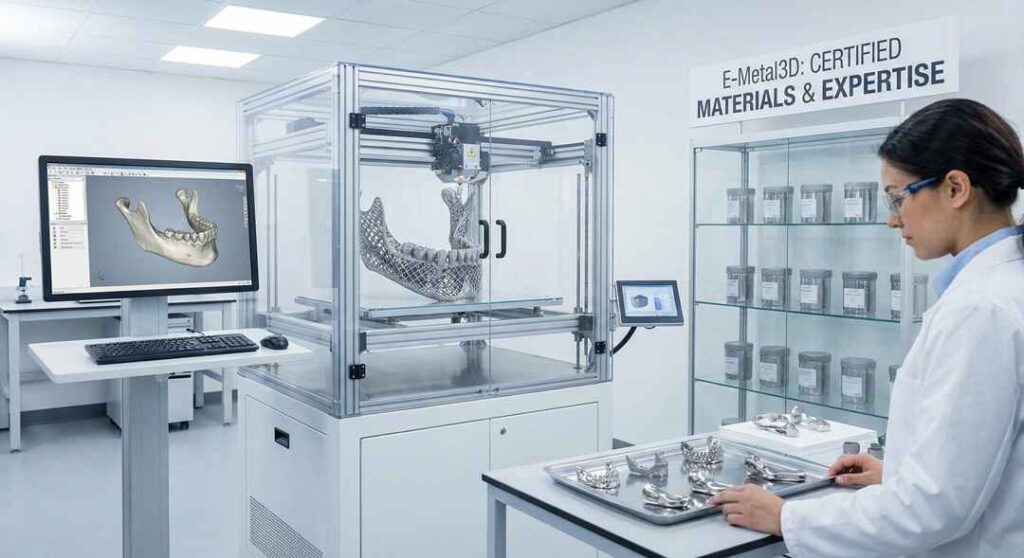
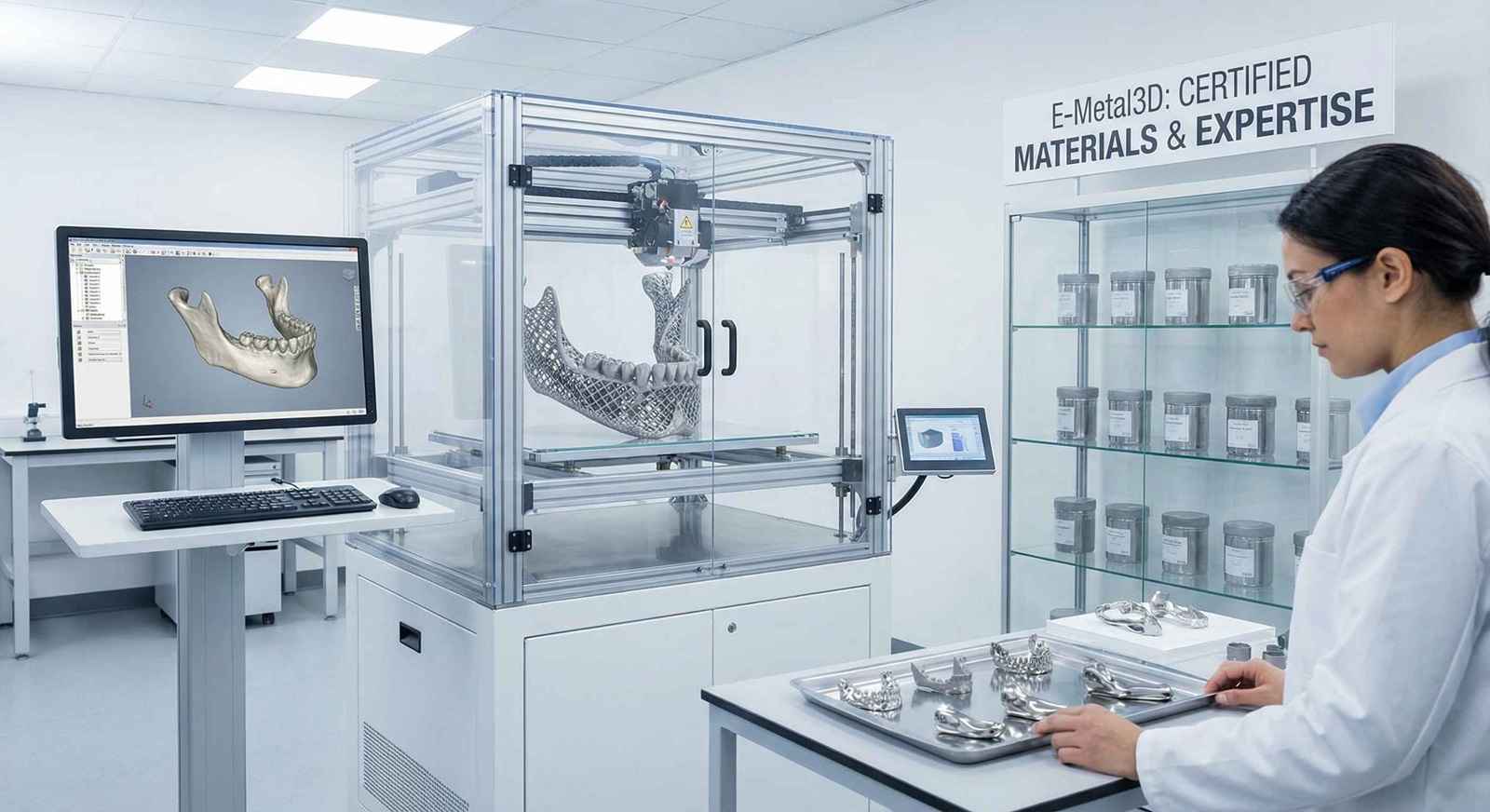
Metal additive manufacturing (AM), particularly Laser Powder Bed Fusion (LPBF), has revolutionized medical device prototyping. At E-Metal3D, we leverage over 20 years of engineering expertise and cutting-edge metal 3D printing technology to help medical manufacturers rapidly prototype devices that meet exacting standards.
This article explores how rapid prototyping with metal AM accelerates product development, reduces costs, and improves outcomes in the medical sector.
The Advantages of Metal AM in Medical Rapid Prototyping
1. Design Freedom and Complexity
-
Metal AM allows the creation of complex geometries, internal channels, and lattice structures that traditional methods cannot achieve.
-
Surgeons and engineers can experiment with innovative designs for implants, surgical guides, and medical instruments without design constraints.
2. Time Efficiency
-
Traditional prototyping can take weeks or months, delaying development cycles.
-
Metal AM enables same-day or multi-day production of prototypes, significantly reducing time-to-market for medical devices.
3. Cost Savings
-
Eliminates the need for costly tooling, molds, and multiple machining steps.
-
Reduces material waste, as AM builds parts layer by layer, using only the required metal powder.
4. Patient-Specific Prototyping
-
Using CT or MRI scan data, engineers can produce patient-specific prototypes to evaluate fit, function, and ergonomics.
-
Enables early testing of implants, surgical guides, or instruments tailored to individual patients.
Process of Rapid Prototyping in Medical AM
Step 1: Digital Design
-
Computer-Aided Design (CAD) and simulation software are used to create a digital model of the medical device.
-
Engineers can run virtual tests for mechanical stress, fluid dynamics, and anatomical compatibility before printing.
Step 2: Material Selection
-
Choosing the right medical-grade metal powder is crucial:
-
Titanium Ti6Al4V: Lightweight, strong, biocompatible
-
Stainless Steel 316L: Corrosion-resistant, durable
-
Cobalt-Chrome (CoCr): Excellent mechanical strength and wear resistance
-
Step 3: Additive Manufacturing
-
The LPBF process builds the prototype layer by layer, following the digital design with micron-level precision.
-
Complex internal geometries, lattice infills, and customized features are accurately produced.
Step 4: Post-Processing
-
Heat treatment, machining, polishing, or bead blasting are applied to achieve desired mechanical properties, surface finish, and dimensional accuracy.
-
Ensures prototypes are functional, safe, and representative of final production parts.
Step 5: Testing and Validation
-
Functional tests, ergonomic assessments, and surgical simulations are conducted on prototypes.
-
Enables iterative improvements before committing to full-scale production.
Case Applications of Rapid Prototyping in Medical Devices
1. Orthopedic Implants
-
Hip, knee, spinal, and cranial implants can be prototyped exactly to patient anatomy.
-
Engineers evaluate fit, mechanical integrity, and surface compatibility before producing final implants.
2. Surgical Guides
-
Custom guides allow surgeons to execute precise cuts or drilling paths during surgery.
-
Rapid prototyping allows multiple iterations to optimize the guide for ergonomics and accuracy.
3. Dental Applications
-
Crowns, bridges, and orthodontic devices are produced as functional prototypes for patient evaluation.
-
Enables dentists and engineers to assess aesthetics, comfort, and functionality prior to final fabrication.
4. Medical Instruments
-
Customized surgical tools can be tested for ergonomics, precision, and mechanical performance.
-
Iterative prototyping allows refinements without expensive tooling changes.
Benefits of Rapid Prototyping Using Metal AM
Shortened Development Cycles
-
Metal AM reduces design-to-test cycles from months to days, enabling faster innovation.
Cost Efficiency
-
Eliminates multiple manufacturing steps, reduces material waste, and lowers the need for expensive tooling.
Enhanced Collaboration
-
Engineers, surgeons, and designers can review and iterate prototypes collaboratively, reducing design errors.
Patient-Centric Design
-
Tailored prototypes ensure devices meet individual anatomical and functional requirements, improving outcomes.
Risk Reduction
-
Early-stage prototypes allow functional testing and failure identification before mass production, mitigating clinical risks.
Quality Assurance and Regulatory Considerations
Even for prototypes, medical devices must comply with ISO, ASTM, and FDA guidelines. E-Metal3D ensures:
-
Material traceability for each powder batch
-
Process documentation for LPBF printing parameters
-
Dimensional and mechanical testing for functional prototypes
-
Controlled post-processing for biocompatibility and surface finish
This rigorous QA framework ensures that prototypes are representative of production parts and suitable for clinical evaluation.
Integration with Digital Healthcare Workflows
Rapid prototyping integrates seamlessly with digital patient data and hospital workflows:
-
CT and MRI scan data can be directly converted into CAD models.
-
Digital simulations allow virtual fitting and surgical planning before physical printing.
-
Rapid prototyping enables on-demand iteration, improving surgical precision and patient outcomes.
Future of Rapid Prototyping in Medical AM
-
AI-driven Design: Predicting optimal geometries for implants and instruments.
-
Digital Twin Technology: Simulating prototype performance under physiological conditions.
-
Automated Quality Inspection: Real-time feedback on printer performance and part accuracy.
-
Sustainable Production: Localized, on-demand prototyping reduces material waste and logistics footprint.
These innovations will further accelerate medical device development, improving patient outcomes and reducing time-to-market.
Conclusion: Driving Innovation with E-Metal3D
Rapid prototyping using metal additive manufacturing transforms medical device development:
-
Faster design-to-test cycles
-
Cost-efficient and flexible production
-
Patient-specific customization
-
Reduced clinical risks and improved outcomes
E-Metal3D empowers medical manufacturers with cutting-edge metal 3D printing technology, certified medical-grade powders, and engineering expertise to bring prototypes from concept to clinical evaluation quickly, reliably, and safely.
By combining precision engineering, regulatory compliance, and iterative prototyping, E-Metal3D helps medical innovators stay ahead in a competitive landscape.