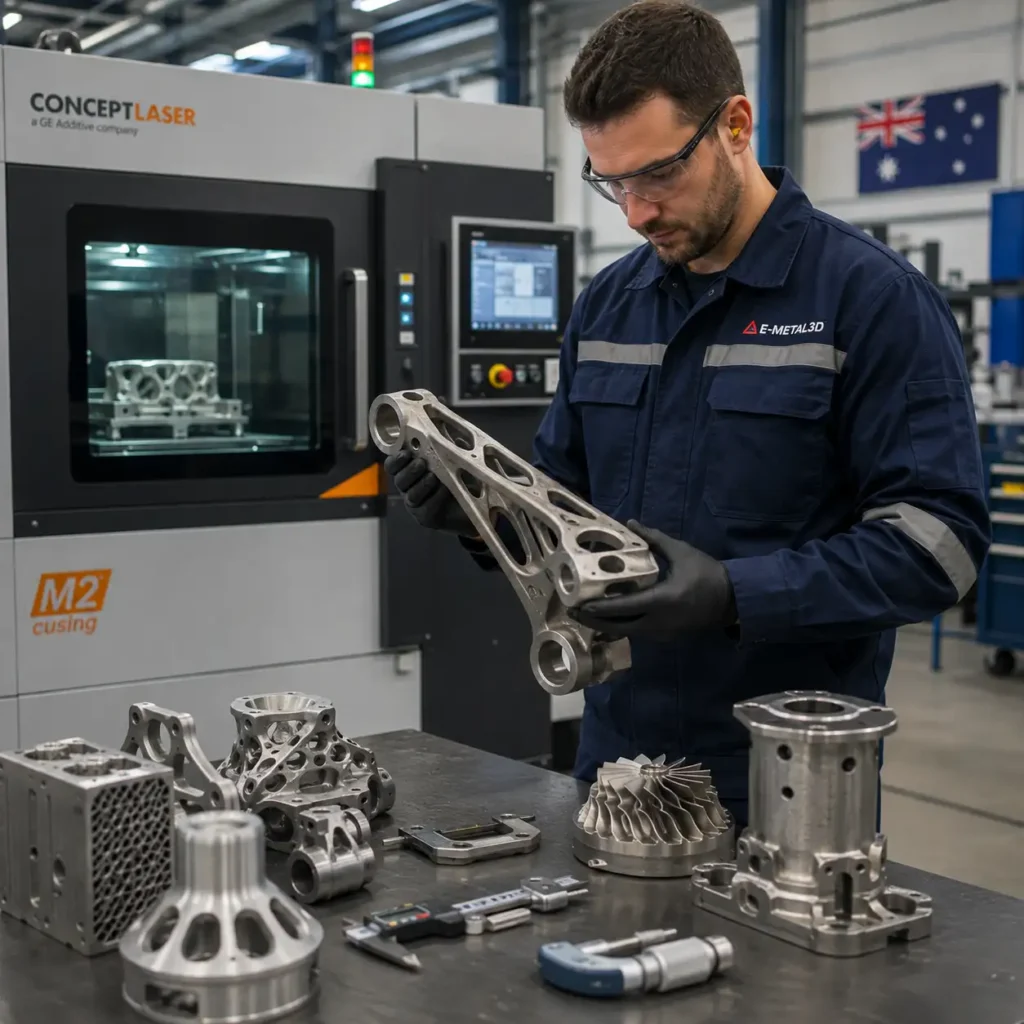
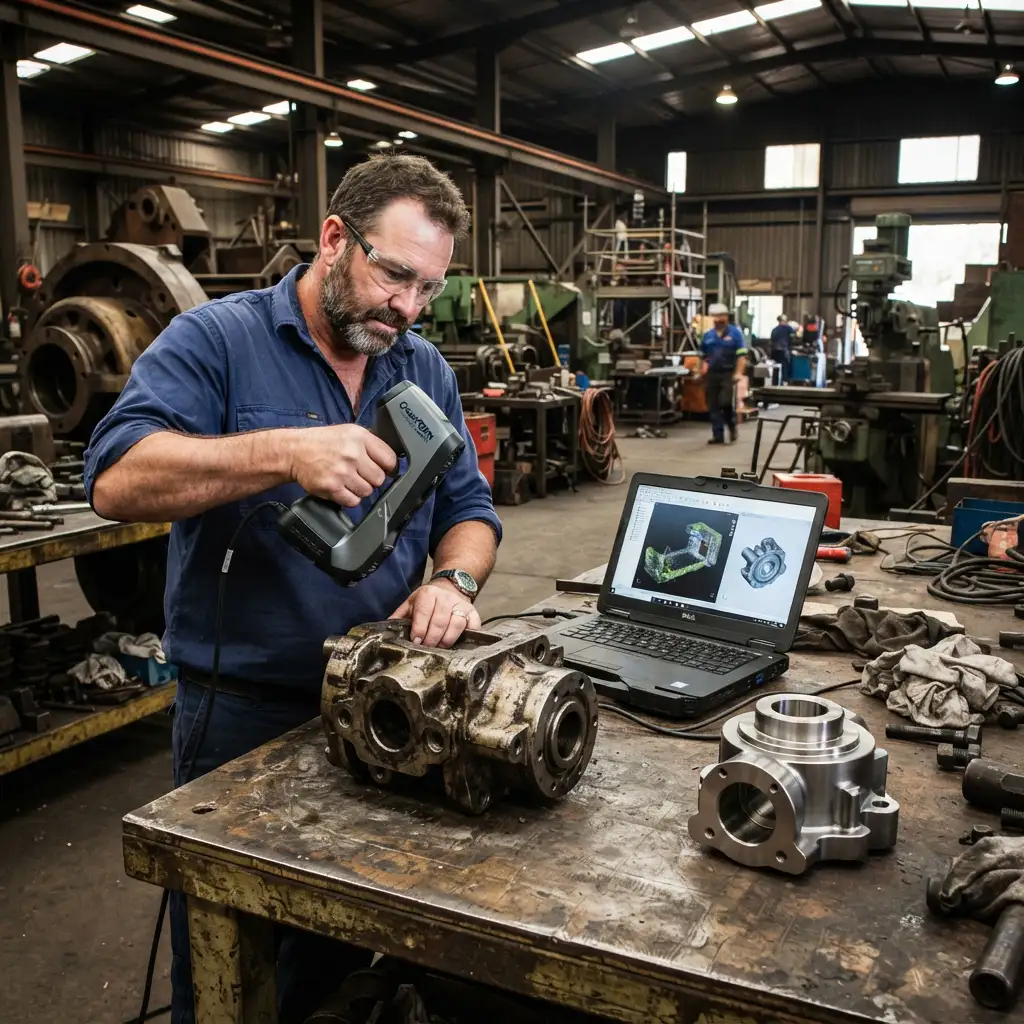
Reverse engineering services help Australian engineering, mining and manufacturing companies turn existing physical components into accurate digital designs that can be inspected, redesigned and manufactured. By combining 3D scanning, scan-to-CAD workflows and engineering analysis, reverse engineering can recover the geometry and design intent of components when original drawings or CAD files are unavailable, outdated or no longer reliable.
For industries that rely on specialised machinery and long-lived equipment, this capability can be particularly valuable. A worn mining component, obsolete machine part or discontinued industrial component does not necessarily need to be redesigned from scratch. Its physical geometry can provide the starting point for rebuilding a usable digital model and, where appropriate, developing an improved replacement.
What Is Reverse Engineering?
Reverse engineering is the engineering process of analysing an existing physical component to recreate its geometry, dimensions, functional characteristics and, where possible, its original design intent.
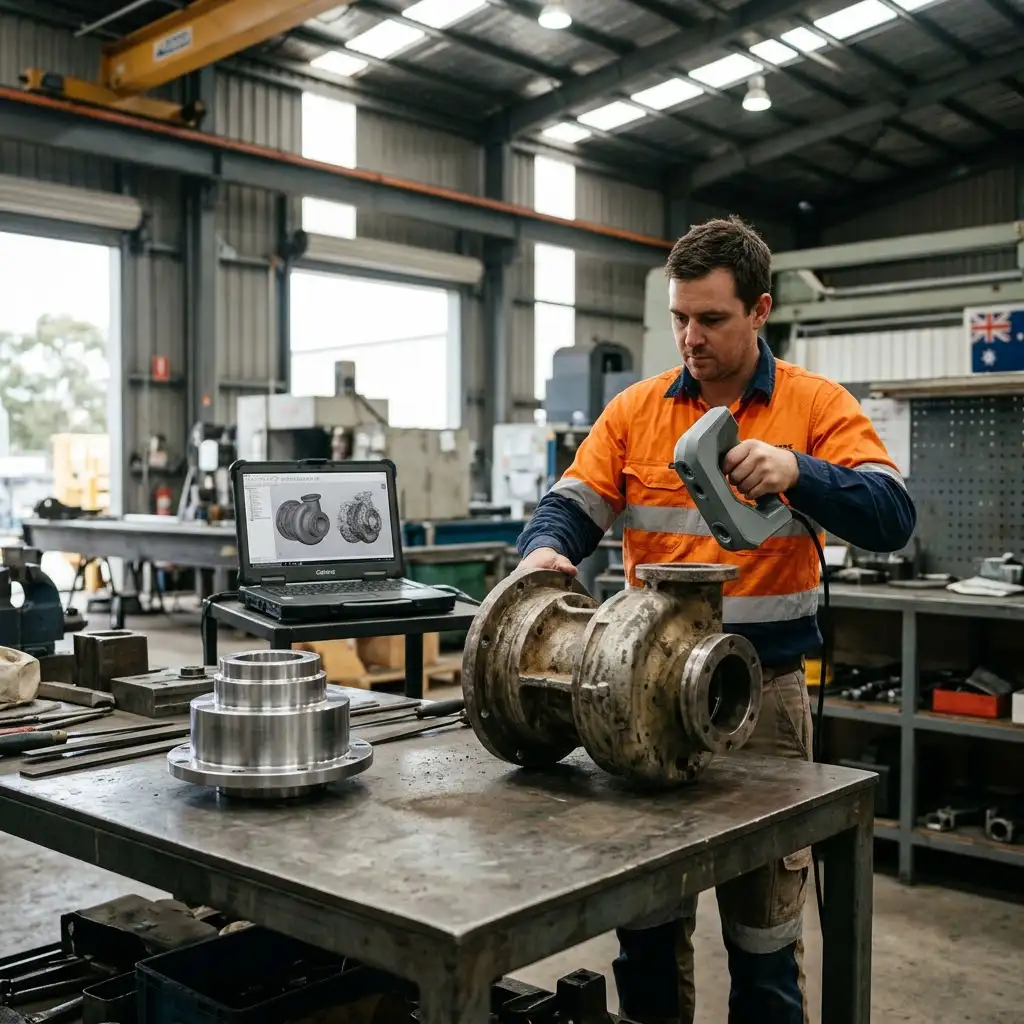
The process typically begins with an existing component rather than an original CAD model. The physical part is inspected and scanned to capture its geometry. The resulting scan data is then processed and converted into a usable digital representation, which may include a mesh, surface model or parametric CAD model.
The objective is not simply to create a visual copy of the component.
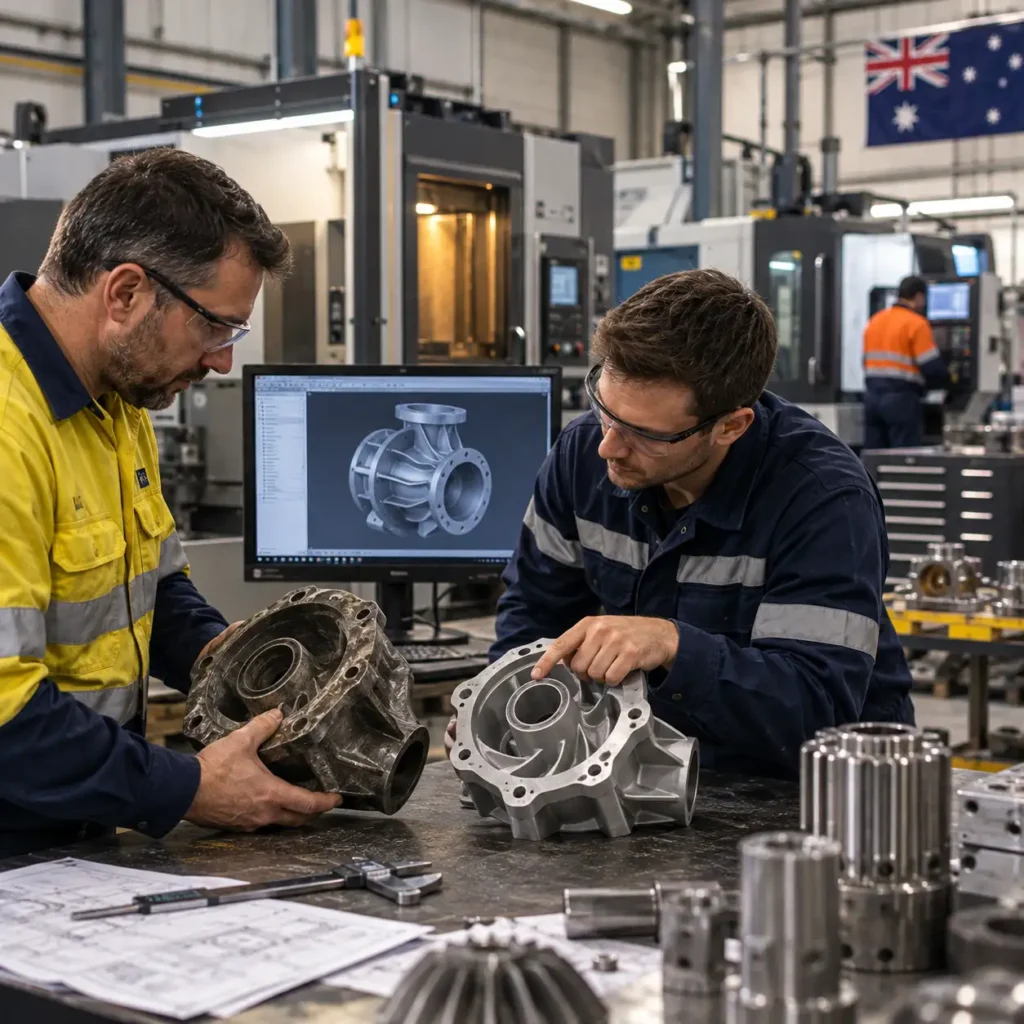
A properly executed reverse engineering workflow considers how the component was designed to function, how it interfaces with surrounding parts, which dimensions are critical, where wear may have occurred and whether the recreated design should reproduce the original geometry or improve upon it.
This distinction is important for industrial applications where dimensional accuracy and functional performance directly affect manufacturing and equipment reliability.
Why Australian Companies Need Reverse Engineering Services
Many industrial components remain in service long after their original design documentation has become difficult to access.
Original CAD files may have been created in obsolete software, stored in inaccessible systems or lost during changes in ownership. Drawings may also represent an earlier version of a component, while the physical part currently in service may have been modified over time.
In mining, manufacturing, oil and gas and other industrial environments, companies may also operate equipment that includes proprietary, customised or legacy components.
Reverse engineering provides a practical way to recover usable engineering information directly from the physical component.
Instead of relying entirely on incomplete documentation, engineers can capture the geometry of the existing part, reconstruct the digital model and use that information as the basis for inspection, redesign or manufacturing.
This can support applications such as:
- Recreating obsolete or discontinued components
- Replacing damaged or worn industrial parts
- Recovering CAD data for legacy equipment
- Supporting local manufacturing of imported components
- Developing digital spare-parts libraries
- Improving existing component designs
- Preparing components for metal additive manufacturing
- Comparing manufactured parts against their intended geometry
3D Scanning as the Starting Point for Reverse Engineering
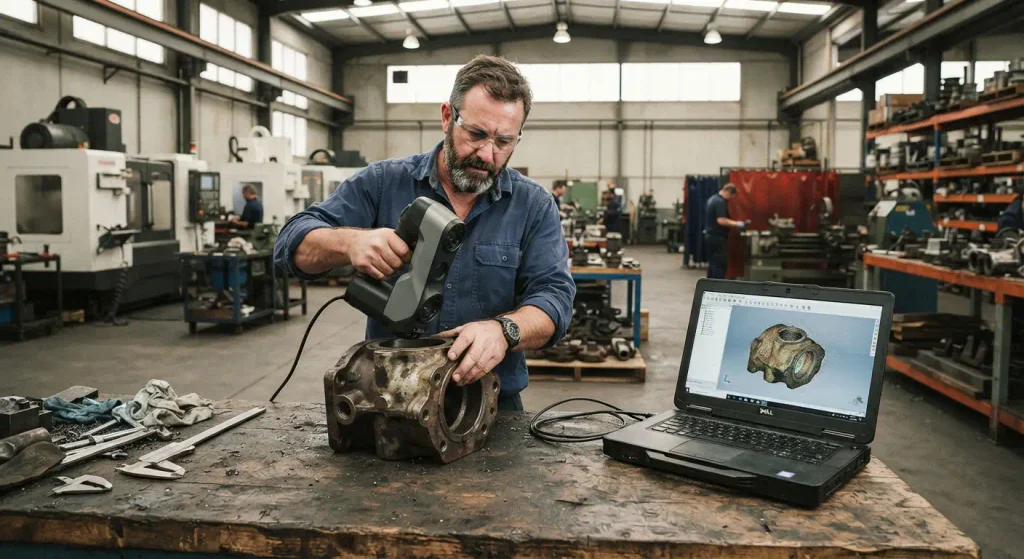
Industrial 3D scanning is often the first technical stage in a modern reverse engineering workflow.
A 3D scanner captures the physical geometry of a component and produces a digital representation consisting of large amounts of spatial data. Depending on the scanning method and application, the output may be a point cloud or polygon mesh that represents the external geometry of the part.
This approach is particularly useful for components with complex surfaces, irregular geometries, organic shapes or features that would be difficult to measure manually.
However, scanning and reverse engineering are not the same process.
Scanning captures geometry.
Reverse engineering interprets that geometry and converts it into engineering information that can be used for design, analysis and manufacturing.
This distinction becomes especially important when the final requirement is a usable CAD model rather than simply a digital copy of the physical object.
From Scan Data to CAD
Once the physical component has been scanned, the raw scan data needs to be processed before it can become an engineering model.
The workflow may include point-cloud processing, noise removal, alignment, mesh generation, surface reconstruction and feature identification.
For simple components, the resulting geometry may be relatively straightforward to reconstruct. More complex industrial parts can require considerably more engineering interpretation.
Critical features such as holes, bores, mounting surfaces, threads, mating interfaces, shafts, sealing surfaces and other functional geometries need to be identified and reconstructed appropriately.
The final CAD model should represent the component in a way that supports its intended use.
Depending on the application, this may mean creating a surface model that closely follows the scanned geometry or developing a parametric solid model that allows dimensions and design features to be controlled within a conventional CAD environment.
This is where scan-to-CAD services become an important part of the reverse engineering process.
Reconstructing Design Intent
A physical component does not directly reveal every decision that went into its original design.
For example, a worn surface may no longer represent its original dimension. A damaged edge may have changed its geometry. A mating surface may contain manufacturing tolerances that cannot be identified simply by looking at a scan.
Engineering judgement is therefore required to distinguish between intentional design features and changes caused by wear, damage, corrosion or previous modifications.
Reconstructing design intent can involve analysing:
- Functional interfaces
- Symmetry and geometric relationships
- Critical dimensions
- Mounting locations
- Wall thickness
- Radii and fillets
- Clearances
- Fastener locations
- Machining features
- Wear patterns
- Interfaces with adjacent components
The result is a digital model that is not simply a photographic representation of the physical component, but an engineering interpretation that can be used for subsequent design and manufacturing activities.
Reverse Engineering Worn and Obsolete Components
One of the most useful applications of reverse engineering is the recreation of components that are no longer available from the original manufacturer.
A component may still be physically available in a maintenance workshop even when its drawings, CAD files or supplier information are no longer accessible.
In this situation, the existing part can become the reference for rebuilding the digital design.
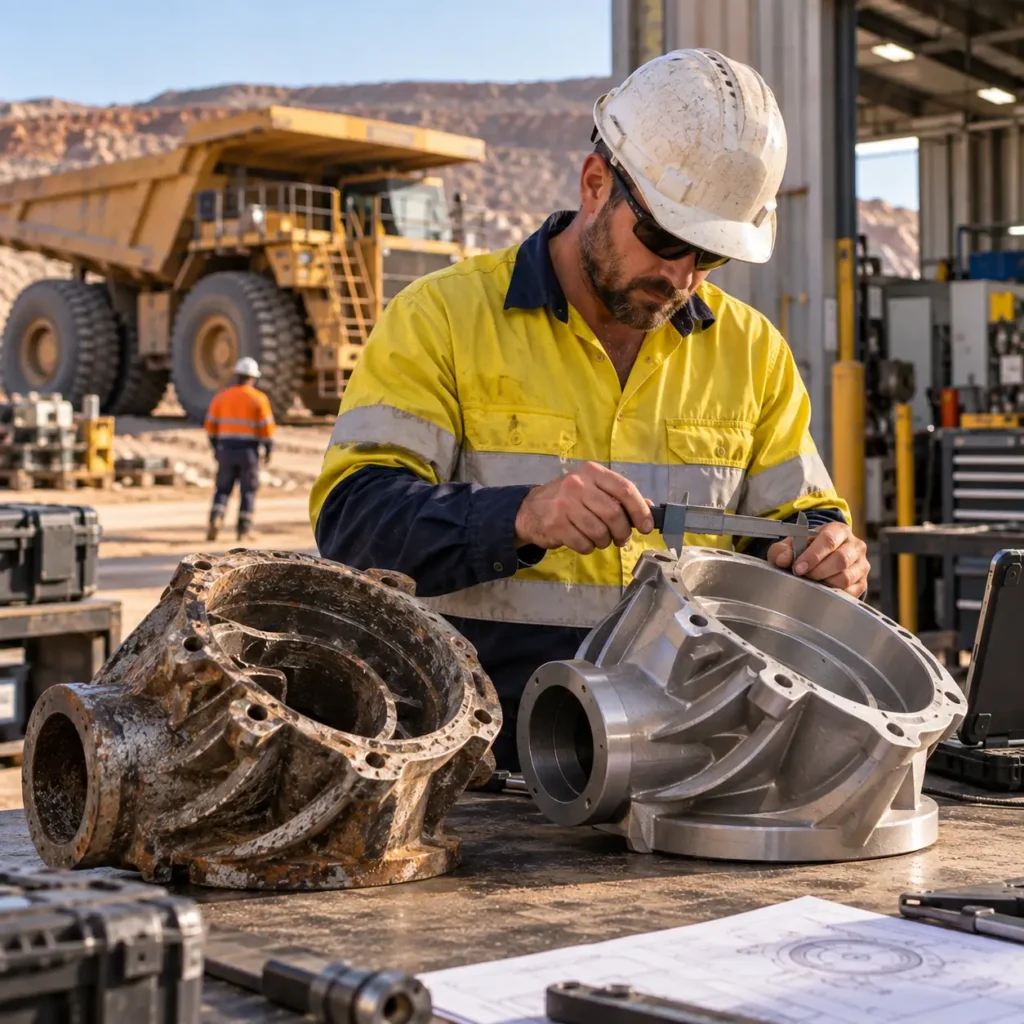
For worn components, however, engineers need to determine which areas represent the original design and which have changed through service.
A worn shaft, housing, impeller, bracket or other mechanical component may have experienced dimensional changes during operation. Simply reproducing the worn geometry could therefore reproduce the problem rather than the intended design.
Combining scanning with inspection and engineering analysis allows the digital reconstruction to account for these factors before a replacement is manufactured.
Reverse Engineering for Mining Equipment
Mining equipment presents a particularly strong application for reverse engineering because machinery often operates in demanding environments and includes specialised components that can be difficult to replace quickly.
Mining components may experience abrasion, impact, corrosion, fatigue and high mechanical loads. Equipment can also remain in operation for many years, creating situations where replacement components are difficult to source or original design documentation is incomplete.
Reverse engineering can support the recreation of components such as:
- Pump and valve components
- Wear parts
- Brackets and structural components
- Hydraulic components
- Custom machine parts
- Guards and housings
- Legacy equipment components
- Specialised maintenance parts
For mining operators and maintenance teams, the value is not limited to creating a digital copy.
The reverse engineered model can become the starting point for design optimisation, material evaluation and alternative manufacturing approaches.
For example, a worn component can be scanned, reconstructed in CAD and then evaluated for opportunities to improve its geometry or manufacturing method.
This connects reverse engineering directly with the broader process of design optimization for mining components.
Reverse Engineering for Manufacturing
Manufacturers can also use reverse engineering when working with legacy machinery, imported components or parts for which complete technical documentation is unavailable.
A physical component can provide the geometric reference required to recreate a manufacturing-ready model.
This can be useful when:
- A supplier has discontinued a component
- Original CAD files are unavailable
- A replacement needs to be manufactured locally
- An imported component needs an Australian manufacturing alternative
- Existing tooling needs to be recreated
- A component requires dimensional verification
- A legacy machine needs ongoing spare-parts support
Once the CAD model has been reconstructed, engineers can assess the most appropriate manufacturing process.
Depending on the geometry, material, quantity, tolerances and application, this could involve conventional machining, fabrication, casting or metal additive manufacturing.
Combining Reverse Engineering with Design Optimization
Reverse engineering does not have to stop at reproducing an existing component.
In many applications, the recreated CAD model becomes the baseline for engineering improvement.
After the original geometry has been recovered, engineers can assess whether the component can be made lighter, stronger, more efficient, easier to manufacture or better suited to its operating environment.
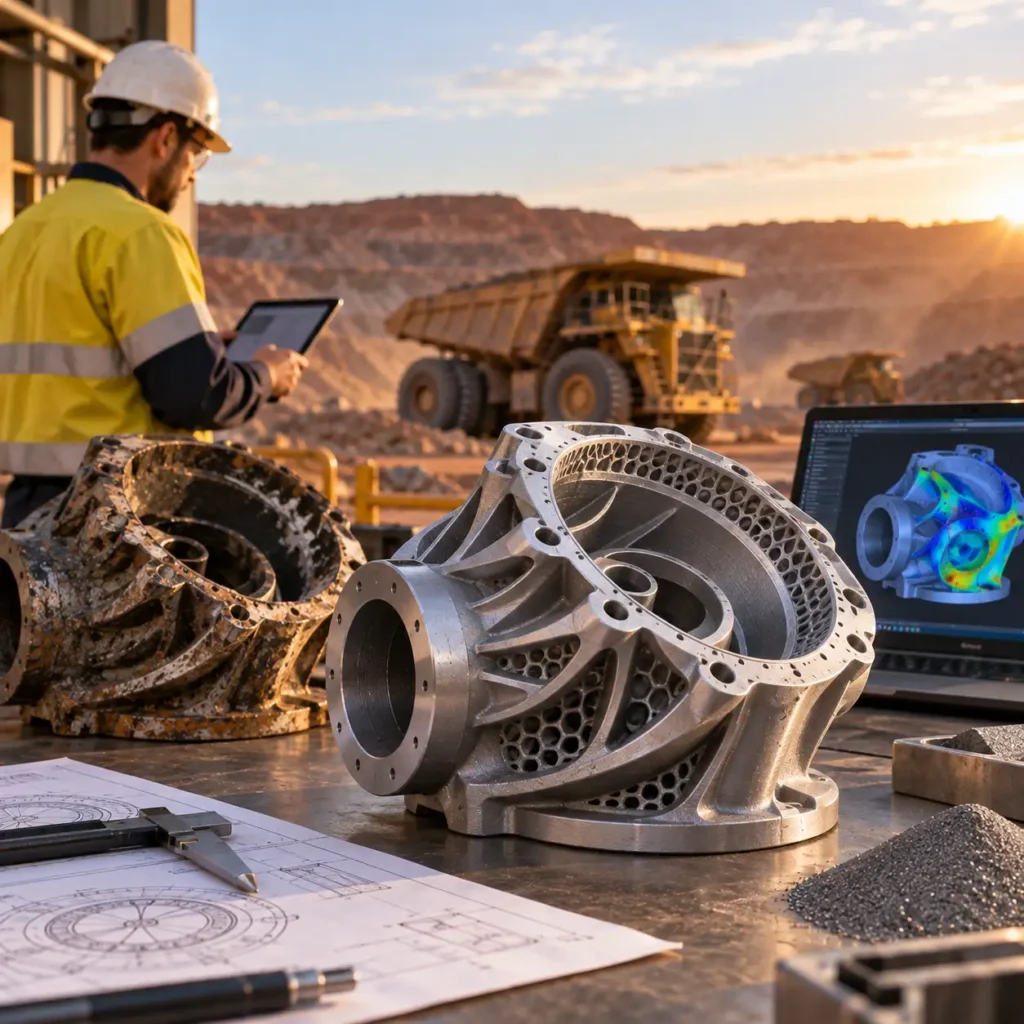
Design optimization techniques may include topology optimization, finite element analysis, geometric redesign, part consolidation and the development of internal structures that would be difficult or impossible to produce using conventional manufacturing.
This is particularly relevant when reverse engineering is combined with metal additive manufacturing.
Instead of manufacturing an exact copy of an old component, the digital model can be used as the starting point for developing a new generation of the component.
The objective becomes:
Physical component → 3D scan → CAD reconstruction → engineering analysis → optimized design → manufactured replacement
This workflow allows companies to preserve useful design information while still taking advantage of modern engineering and manufacturing capabilities.
From Reverse Engineering to Metal 3D Printing
Metal additive manufacturing can provide an additional manufacturing route once a reverse engineered component has been converted into an appropriate digital model.
This is especially relevant for low-volume, complex or specialised components where conventional tooling or machining may be inefficient.
A reverse engineered part can be redesigned for additive manufacturing by considering factors such as build orientation, support requirements, wall thickness, internal channels, lattice structures, part consolidation and post-processing requirements.
The resulting component may therefore differ from the original physical part while maintaining its required functional interfaces.
This approach is often more valuable than simply reproducing the original manufacturing limitations.
For example, a component originally produced as several assembled pieces may potentially be redesigned as a consolidated part. Internal flow paths may also be redesigned where the application allows it, while unnecessary material can be removed from low-stress regions.
The reverse engineering process therefore provides the digital foundation, while additive manufacturing can provide a new manufacturing opportunity.
Building Digital Spare-Parts Libraries
Another important benefit of reverse engineering is the creation of digital spare-parts data.
Once a physical component has been scanned and reconstructed, its CAD model can become part of a controlled digital library.
This can help organisations build a digital record of critical components that may otherwise exist only as physical parts.
A digital spare-parts library can support:
- Faster component identification
- Future replacement manufacturing
- Design revision management
- Dimensional reference
- Local production
- On-demand manufacturing
- Maintenance planning
- Preservation of legacy equipment information
For organisations operating large fleets of equipment, progressively digitising critical components can reduce dependence on individual physical samples and improve access to engineering information.
Reverse Engineering and Local On-Demand Manufacturing
The combination of reverse engineering and local manufacturing can be particularly useful when replacement components have long lead times.
Once a component has been converted into a validated digital model, the design can potentially be manufactured when required rather than relying entirely on maintaining large inventories of physical spare parts.
This does not mean every component should be produced on demand.
Material requirements, certification, tolerances, production volume, economic feasibility and application-specific requirements still need to be considered.
However, for specialised or low-volume components, maintaining accurate digital engineering data can provide greater flexibility when a replacement is eventually required.
For Australian industries operating equipment in remote or geographically dispersed locations, the ability to move from physical component to digital design and then to an appropriate manufacturing process can also support more responsive maintenance strategies.
When Should You Use Reverse Engineering?
Reverse engineering can be considered when an existing physical component contains valuable engineering information but the original digital design is unavailable or unsuitable.
Typical situations include:
The original CAD model is missing:
A physical component may be the only reliable reference available.
The component is obsolete:
Reverse engineering can provide the digital foundation for manufacturing a replacement.
The component is imported:
A local digital model may support alternative sourcing or manufacturing.
The component has been modified:
Scanning can capture the geometry of the component currently in service.
The component needs improvement:
The existing design can become a baseline for engineering optimisation.
A digital spare-parts library is required:
Physical components can be converted into structured engineering data.
The component is difficult to measure manually:
3D scanning can capture complex geometry more efficiently.
The suitability of reverse engineering should still be assessed on a component-by-component basis, particularly where highly critical dimensions, material properties or certification requirements are involved.
Choosing Reverse Engineering Services in Australia
A successful reverse engineering project requires more than access to a 3D scanner.
The quality of the final result depends on the complete workflow, from physical inspection and scanning through to CAD reconstruction and engineering validation.
When evaluating reverse engineering services in Australia, companies should consider whether the provider can support the complete process rather than only the scanning stage.
Important considerations include:
- Industrial 3D scanning capability
- Appropriate measurement and inspection methods
- Scan-to-CAD expertise
- CAD reconstruction capability
- Understanding of manufacturing processes
- Engineering analysis
- Experience with complex industrial components
- Ability to work with mining and manufacturing applications
- Understanding of additive manufacturing where relevant
- Clear communication of accuracy and limitations
The most useful workflow is one that connects measurement, engineering and manufacturing rather than treating each stage as an isolated service.
Reverse Engineering as a Digital Engineering Workflow
Modern reverse engineering is increasingly becoming part of a broader digital engineering process.
The physical component provides the initial reference. 3D scanning captures its geometry. CAD reconstruction converts the scan into an editable engineering model. Inspection and analysis provide confidence in the reconstructed design. Engineering optimisation can then improve the component where appropriate, and manufacturing technologies can turn the final design back into a physical part.
This creates a practical connection between physical assets and digital engineering.
For Australian mining, manufacturing and industrial companies, that connection can be particularly valuable when dealing with legacy equipment, specialised components and supply-chain challenges.
Conclusion
Reverse engineering services provide a practical pathway for converting existing physical components into usable digital engineering data.
By combining 3D scanning, scan-to-CAD, CAD reconstruction and engineering analysis, companies can recreate obsolete or undocumented components, establish digital spare-parts libraries and create a foundation for local manufacturing.
The process can also go beyond simple duplication. Once the original geometry has been recovered, the component can be evaluated for design optimisation and alternative manufacturing methods, including metal additive manufacturing.
For Australian engineering, mining and manufacturing operations, reverse engineering can therefore form an important link between existing physical assets and modern digital manufacturing workflows.
E-Metal3D combines industrial 3D scanning, engineering solutions and metal additive manufacturing capabilities to help companies move from physical components to digital engineering and manufacturing solutions.
What are reverse engineering services?
Reverse engineering services involve analysing an existing physical component and recreating its geometry and engineering information as a digital model. The process can include 3D scanning, scan-to-CAD, CAD reconstruction, inspection and engineering analysis.
What is the difference between 3D scanning and reverse engineering?
3D scanning captures the geometry of a physical object and produces digital measurement data. Reverse engineering uses that data, together with engineering analysis, to reconstruct a usable design or CAD model and determine how the component can be reproduced, modified or manufactured.
Can a worn component be reverse engineered?
Yes, but the effects of wear and damage need to be considered. Simply copying worn geometry may reproduce dimensional errors. Engineering inspection and analysis can help distinguish original design features from changes caused by service conditions.
Can reverse engineering be used for mining components?
Yes. Reverse engineering can be used for mining components that are obsolete, difficult to source, undocumented or in need of redesign. Combining 3D scanning with CAD reconstruction can provide a digital foundation for replacement manufacturing and design optimisation.
Can reverse engineering be used for metal 3D printing?
Yes. A reverse engineered CAD model can be used as the starting point for designing a component for metal additive manufacturing. The geometry can then be adapted for additive manufacturing requirements such as build orientation, supports, wall thickness and part consolidation.
What is scan-to-CAD?
Scan-to-CAD is the process of converting 3D scanning data into a usable CAD model. Depending on the component and application, this may involve mesh processing, surface reconstruction, feature recognition and parametric CAD modelling.
Can reverse engineering create a digital spare-parts library?
Yes. Once components have been scanned and converted into validated digital models, the resulting engineering data can be organised into a digital spare-parts library for future inspection, redesign or manufacturing.
How accurate is reverse engineering?
Accuracy depends on the scanning technology, component geometry, measurement conditions, data processing and CAD reconstruction methodology. The required accuracy should therefore be defined according to the function, tolerances and manufacturing requirements of the component.