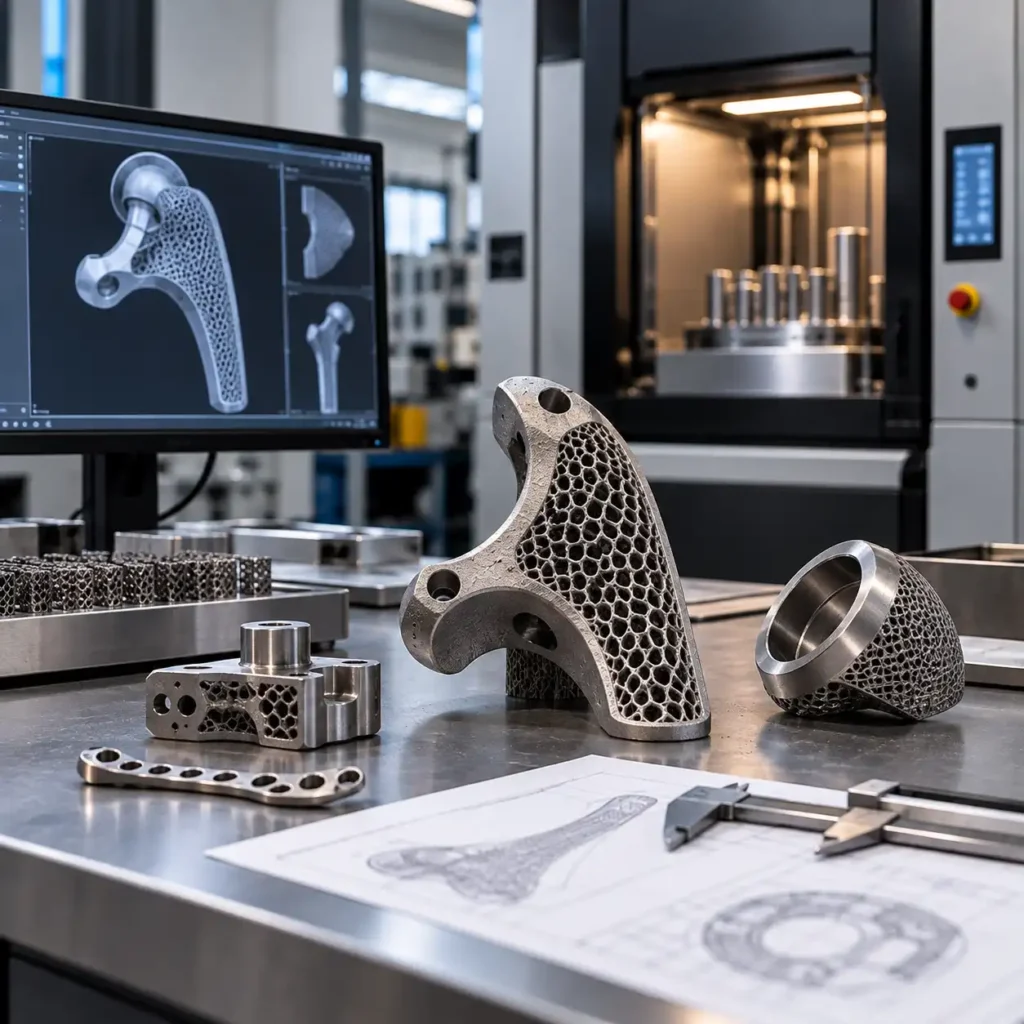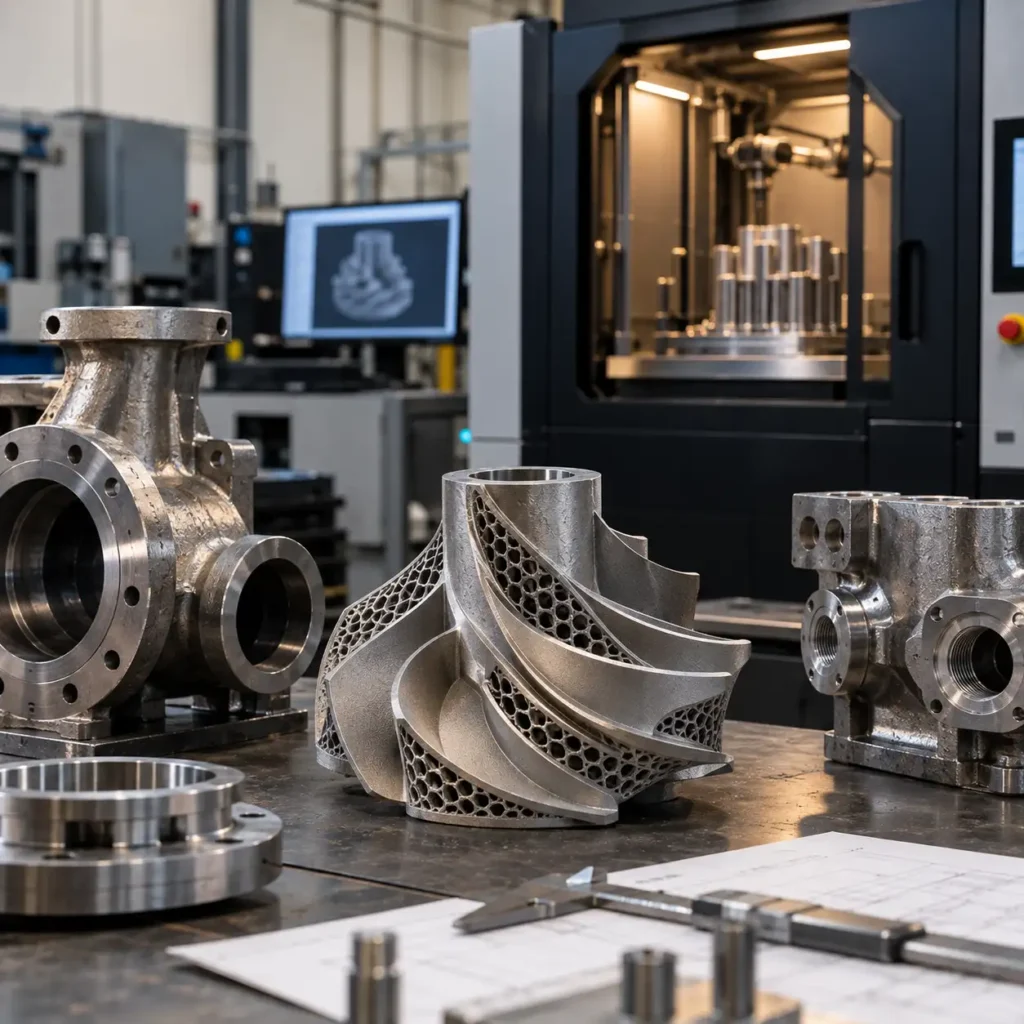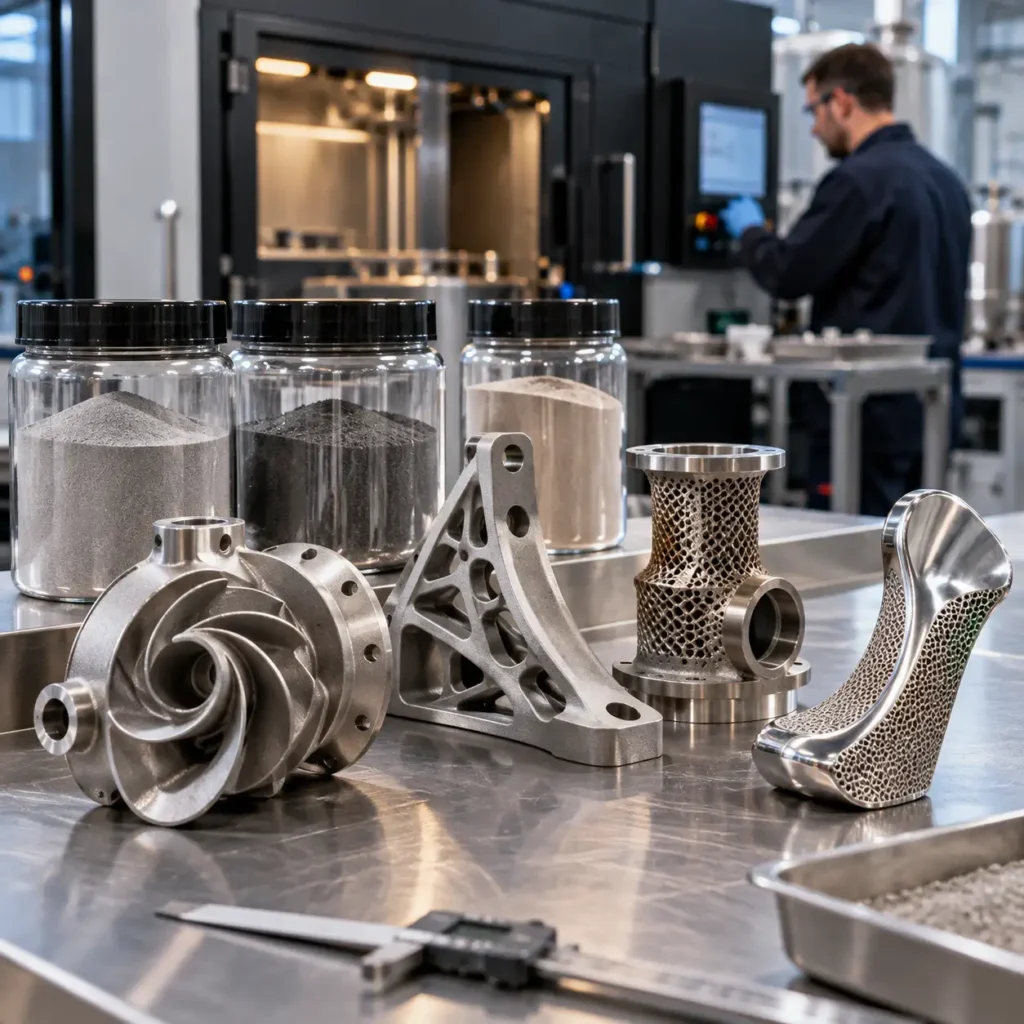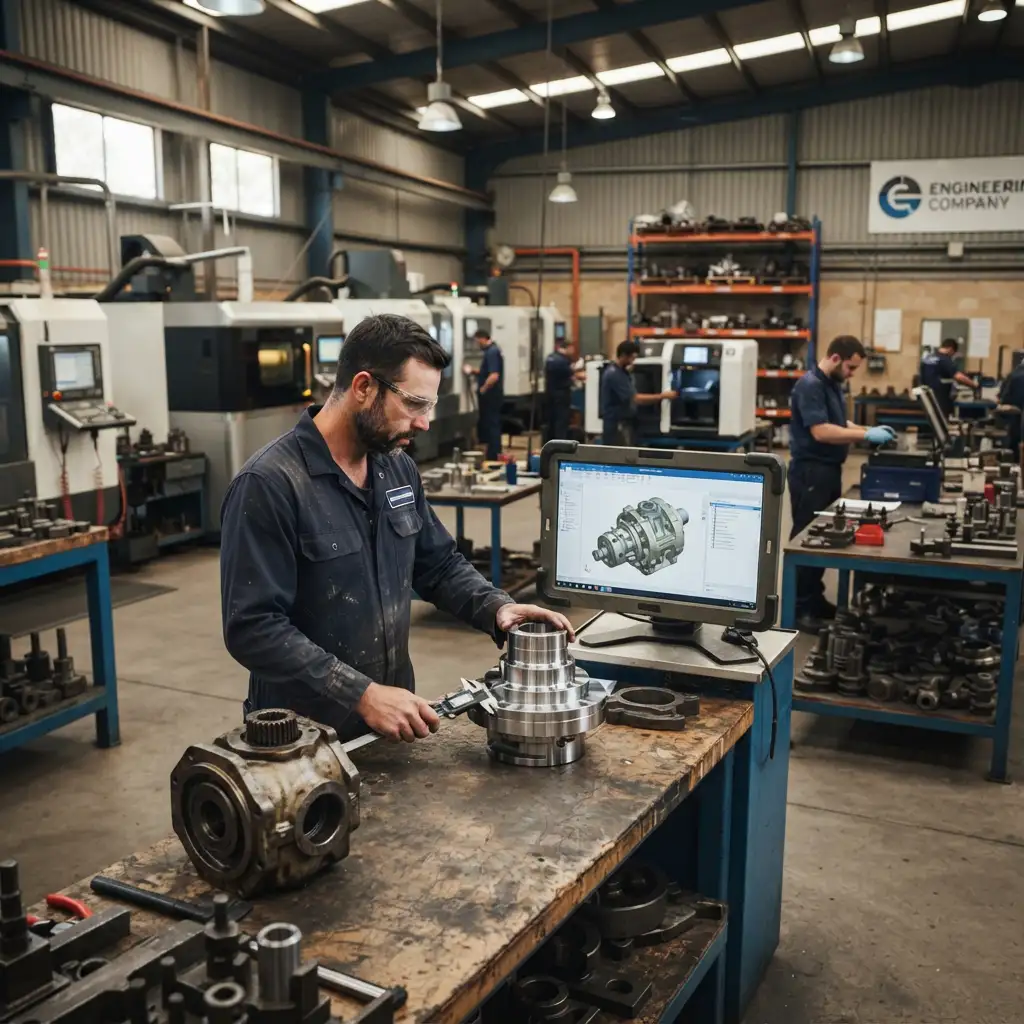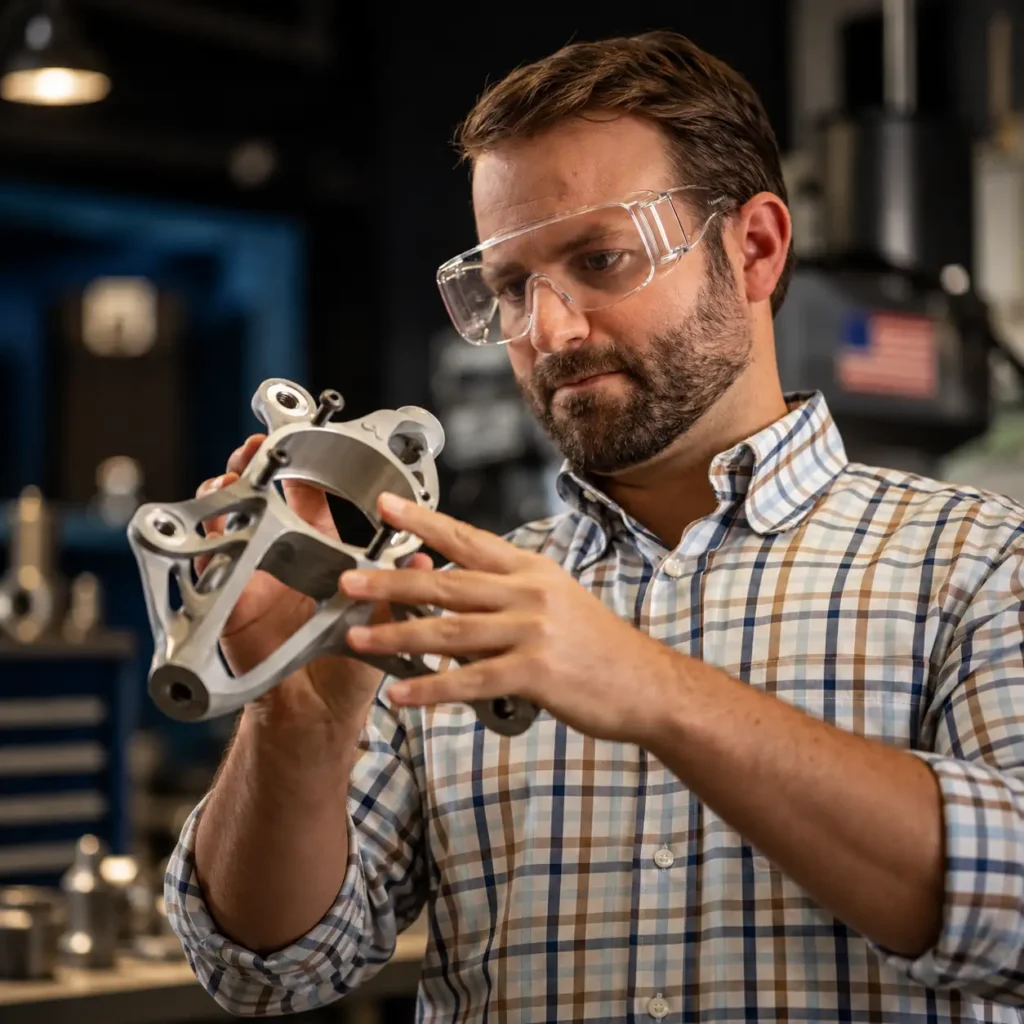
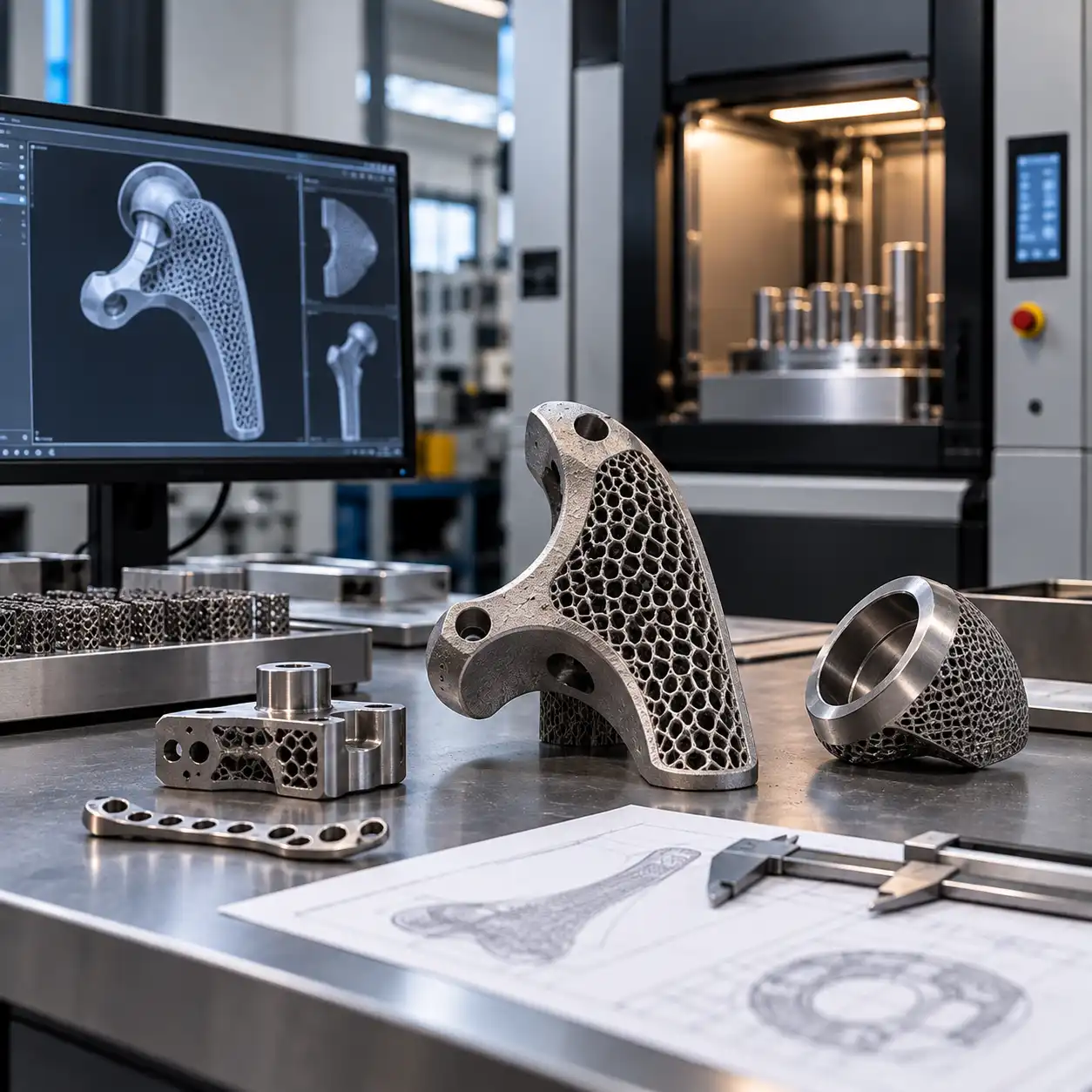
Medical device prototyping Australia supports engineering and product-development teams that need to turn complex digital designs into physical components for evaluation, testing and design refinement. In medical product development, engineers often need to assess more than appearance alone. Geometry, assembly, material behaviour, manufacturing feasibility and functional performance may all need to be understood before a design can progress toward production.
Medical device prototyping allows engineering teams to turn digital designs into physical components that can be assessed, measured and refined before committing to a final manufacturing strategy.
For suitable metal components, additive manufacturing can extend this process beyond conventional visual prototypes. Technologies such as Laser Powder Bed Fusion (LPBF) can manufacture complex metal geometries directly from CAD data, allowing engineers to investigate designs that may be difficult or expensive to prototype using conventional methods.
In Australia, this creates opportunities across medical-device development, research, engineering and specialised manufacturing. However, producing a prototype and producing a regulated medical device are not the same thing. Material selection, manufacturing controls, validation and regulatory requirements must be considered separately according to the intended application.
What Is Medical Device Prototyping?
Medical device prototyping is the process of producing physical versions of a device, component or engineering concept during product development.
A prototype may be created to investigate:
- component geometry;
- physical fit;
- assembly;
- ergonomics;
- mechanical behaviour;
- manufacturing feasibility;
- design iterations;
- testing methodology;
- or communication between engineering and clinical stakeholders.
The prototype does not necessarily represent the final production device.
Early prototypes may be relatively simple and intended primarily to evaluate dimensions or form. Later-stage prototypes can become increasingly representative of the intended component, potentially incorporating production-relevant materials and manufacturing processes.
This distinction matters because the manufacturing method should match the question the prototype is intended to answer.
Why Prototyping Matters in Medical Product Development
Digital engineering tools allow increasingly sophisticated designs to be evaluated before manufacturing.
CAD models can establish geometry. Simulation can help engineers study structural or thermal behaviour. Design reviews can identify obvious problems.
But some engineering questions still benefit from a physical component.
A physical prototype can reveal issues that are difficult to appreciate entirely on screen.
Interfaces may be difficult to access.
Fasteners may interfere with adjacent geometry.
A housing may be unnecessarily bulky.
A component may be difficult to manufacture or inspect.
An assembly sequence may create unexpected constraints.
Prototyping provides an opportunity to identify these issues while the design can still be changed relatively efficiently.
The objective is therefore not simply to “make a sample.”
It is to reduce uncertainty during product development.
Rapid Prototyping for Medical Devices
Rapid prototyping describes manufacturing approaches that shorten the transition from digital design to physical component.
Additive manufacturing is particularly relevant because components can be manufactured directly from CAD geometry without requiring dedicated tooling for every design iteration.
That can be useful when engineers are evaluating multiple versions of a component.
A conventional process might require new fixtures, tooling or manufacturing preparation each time geometry changes.
With additive manufacturing, a revised digital model can potentially become the input for another manufacturing cycle.
This creates a development loop:
CAD Design → Prototype → Evaluate → Modify → Manufacture Again
The value lies less in the word “rapid” itself and more in the ability to perform controlled design iterations without committing immediately to production tooling.
When Does Metal 3D Printing Become Useful?
Polymer additive manufacturing is widely used for early-stage prototypes, particularly where the objective is to evaluate appearance, packaging or basic fit.
But some development questions require a metal component.
Metal 3D printing can become relevant where engineers need to investigate:
- complex metallic geometry;
- thin walls;
- integrated features;
- internal channels;
- lightweight structures;
- mechanical interfaces;
- compact assemblies;
- or designs intended for eventual metal manufacture.
LPBF builds metal components layer by layer from metal powder using a high-energy laser.
Because the component is generated from digital geometry rather than being cut entirely from a larger block of material, engineers gain access to geometries that can be difficult to manufacture conventionally.
That design freedom can be valuable during medical product development—but it also introduces a different set of engineering constraints.
Design for Metal Additive Manufacturing
A CAD model that looks suitable on screen is not automatically suitable for metal additive manufacturing.
Engineers must consider how the geometry will behave during the manufacturing process.
This is the domain of Design for Additive Manufacturing (DfAM).
For LPBF components, considerations can include:
- build orientation;
- support structures;
- overhangs;
- heat accumulation;
- distortion;
- minimum feature dimensions;
- powder removal;
- surface accessibility;
- machining allowances;
- and inspection requirements.
This means additive manufacturing should ideally be considered during design development rather than introduced only after the component has been finalised.
A component designed specifically around additive manufacturing can be substantially different from one originally designed for machining.
From Prototype Geometry to Engineering Component
A useful prototype should answer a defined engineering question.
For example, an early prototype may only need to demonstrate that several components fit within an available envelope.
A later prototype may need to evaluate whether a metal bracket can withstand representative mechanical loading.
Another prototype might investigate whether an internal flow path can be manufactured and subsequently inspected.
These different objectives require different levels of engineering fidelity.
This creates an important principle:
Prototype accuracy should be appropriate to the decision being made.
Producing an expensive, production-like metal prototype is unnecessary when a simple dimensional model can answer the question.
Conversely, using a basic polymer model to draw conclusions about the mechanical performance of a final metal component may provide limited engineering value.
Medical Device Prototyping and Material Selection
Material selection becomes increasingly important as a prototype moves closer to functional testing.
Metal additive manufacturing can process a range of engineering alloys, depending on the manufacturing system and validated process parameters.
Potential material families can include:
- stainless steels;
- titanium alloys;
- cobalt-chrome alloys;
- and selected nickel-based alloys.
But the fact that an alloy can be additively manufactured does not automatically make it suitable for a particular medical application.
Engineers must distinguish between three different questions:
Can this material be printed?
Does the resulting material meet the required engineering properties?
Is the complete manufacturing route appropriate for the intended regulated application?
Those questions are not interchangeable.
Titanium and Medical Product Development
Titanium alloys are strongly associated with medical engineering because they can offer useful combinations of strength, relatively low density and corrosion resistance.
Ti6Al4V is also widely used within metal additive manufacturing.
From a prototyping perspective, titanium LPBF can be useful when engineers need to evaluate complex lightweight metal components or designs that may eventually be produced using additive manufacturing.
One of the most important advantages is not simply the material itself.
It is the combination of material and geometric freedom.
Engineers can investigate structures that would be difficult to create through conventional machining, including topology-optimised forms and certain lattice-type geometries.
However, use of titanium in a prototype should not be interpreted as evidence that the resulting component is automatically suitable for clinical use.
Cobalt Chrome and Medical Additive Manufacturing
Cobalt-chrome alloys are another material family associated with medical and dental applications.
Their combination of wear resistance, strength and corrosion behaviour can make them relevant to specific applications.
Metal additive manufacturing can also process selected cobalt-chrome powders.
As with titanium, however, the material name alone does not establish the regulatory status or suitability of a finished component.
Powder specification, manufacturing parameters, thermal processing, finishing, cleaning, inspection, traceability and the intended application all contribute to the final engineering outcome.
For this reason, discussions of medical-grade 3D printing should focus on the complete manufacturing system rather than treating “medical grade” as a characteristic automatically created by a 3D printer.
Stainless Steel for Medical Engineering Prototypes
Stainless steels can also be valuable during medical product development.
For engineering prototypes, stainless steel may provide a practical route for evaluating:
- structural components;
- housings;
- fixtures;
- tooling;
- mechanical interfaces;
- development hardware;
- and selected device components.
316L is particularly established within metal additive manufacturing.
Its suitability for a particular prototype or final application still depends on design requirements, environment and manufacturing specifications.
This reinforces the importance of selecting material based on the engineering objective of the prototype, rather than simply choosing the most familiar additive-manufacturing alloy.
Prototyping Complex Internal Geometry
One area where additive manufacturing can significantly change product development is internal geometry.
Traditional machining relies on cutting-tool access.
If a cutting tool cannot physically reach a feature, manufacturing that geometry may require multiple components, specialised tooling or alternative processes.
Additive manufacturing changes this constraint because geometry is created progressively during the build.
This can enable development of components containing:
- curved internal passages;
- integrated channels;
- compact manifolds;
- internal cavities;
- and consolidated flow structures.
For medical-device engineers developing fluid-management, thermal-management or compact mechanical systems, this can create useful new design options.
But internal geometry also creates inspection and post-processing challenges.
Design freedom does not remove the need to manufacture, clean and verify the resulting component.
Part Consolidation During Product Development
Medical products can contain assemblies made from multiple small components.
Each additional component introduces interfaces, fasteners, joints, manufacturing operations and assembly requirements.
Additive manufacturing can sometimes allow multiple functions to be incorporated into a single component.
This concept is known as part consolidation.
A development team might investigate whether several machined or fabricated pieces can be redesigned as one additively manufactured component.
Potential benefits can include fewer assembly operations and elimination of selected joints.
But consolidation also changes maintainability, inspection and manufacturing risk.
A single highly complex component may reduce assembly count while becoming more difficult to inspect or replace.
The correct design therefore requires engineering trade-offs rather than simply maximising consolidation.
Topology Optimisation for Lightweight Medical Components
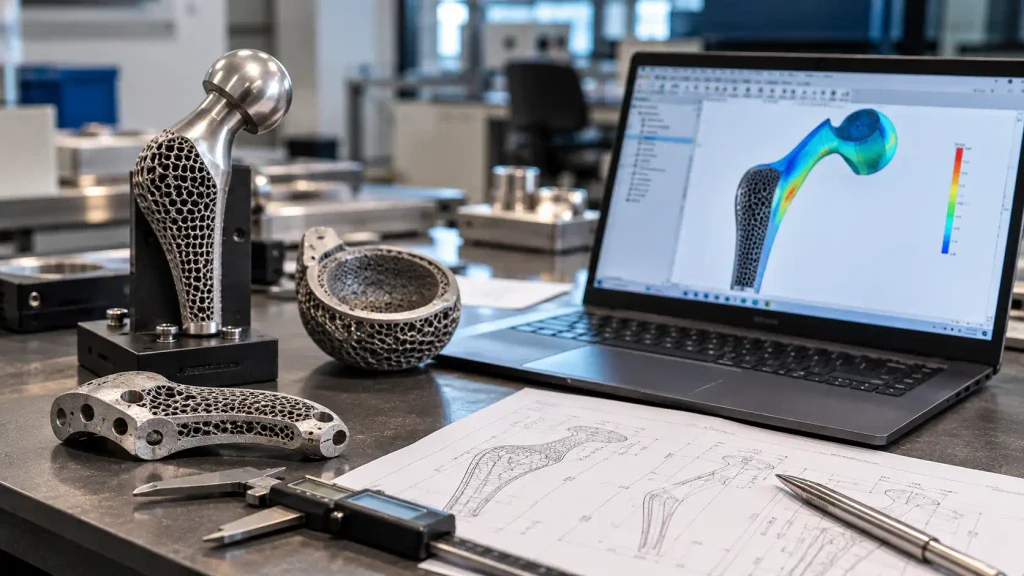
Topology optimisation is another tool that can be combined with additive manufacturing.
Instead of manually determining the shape of a component, engineers can define constraints such as:
- loads;
- mounting locations;
- allowable design space;
- stiffness requirements;
- and manufacturing constraints.
Optimisation software can then identify where material contributes most effectively to structural performance.
The resulting geometry can look very different from a traditionally machined component.
Because additive manufacturing is less constrained by conventional tool access, some of these forms become manufacturable.
For medical-device prototyping, topology optimisation can therefore help engineers explore lightweight structural solutions before committing to a final design.
Functional Prototypes Versus Production Devices
This distinction deserves particular attention in medical manufacturing.
A functional prototype can be extremely useful without being a finished medical device.
It may allow engineers to evaluate:
- structural behaviour;
- assembly;
- dimensional interfaces;
- manufacturing feasibility;
- handling;
- or design modifications.
A production medical device, however, can involve additional requirements covering areas such as:
- risk management;
- manufacturing validation;
- material traceability;
- quality management;
- cleaning;
- sterilisation;
- biocompatibility;
- documentation;
- regulatory classification;
- and verification and validation.
These requirements depend on the device and its intended use.
Therefore:
Successful prototype manufacture does not itself establish regulatory compliance.
That boundary should remain clear throughout medical additive-manufacturing projects.
ISO 13485 and Additive Manufacturing
Search interest around ISO 13485 additive manufacturing reflects an important question within the industry.
ISO 13485 is a quality-management-system standard associated with organisations involved in medical devices.
However, ISO 13485 should not be interpreted as a certification of a particular 3D-printed component simply because it was produced within an organisation operating under such a system.
The regulatory and quality requirements applicable to a medical device depend on the product, manufacturing process, jurisdiction and intended use.
For development teams, the practical implication is that quality and regulatory strategy should be considered early.
If additive manufacturing may eventually become the production process, manufacturing controls and validation requirements should not first be considered after prototype development has finished.
Designing for Inspection
One of the less visible aspects of medical product development is inspection.
A highly complex component may be manufacturable but difficult to verify.
This is particularly important with additive manufacturing because geometric complexity can increase rapidly.
During design, engineers should ask:
How will this feature be measured?
Can critical surfaces be accessed?
Can internal powder be removed?
Can internal geometry be inspected?
Which dimensions actually control functional performance?
This approach is sometimes described as designing for inspectability.
A component that cannot be reliably inspected may create unnecessary difficulty later in development.
Dimensional Inspection and 3D Scanning
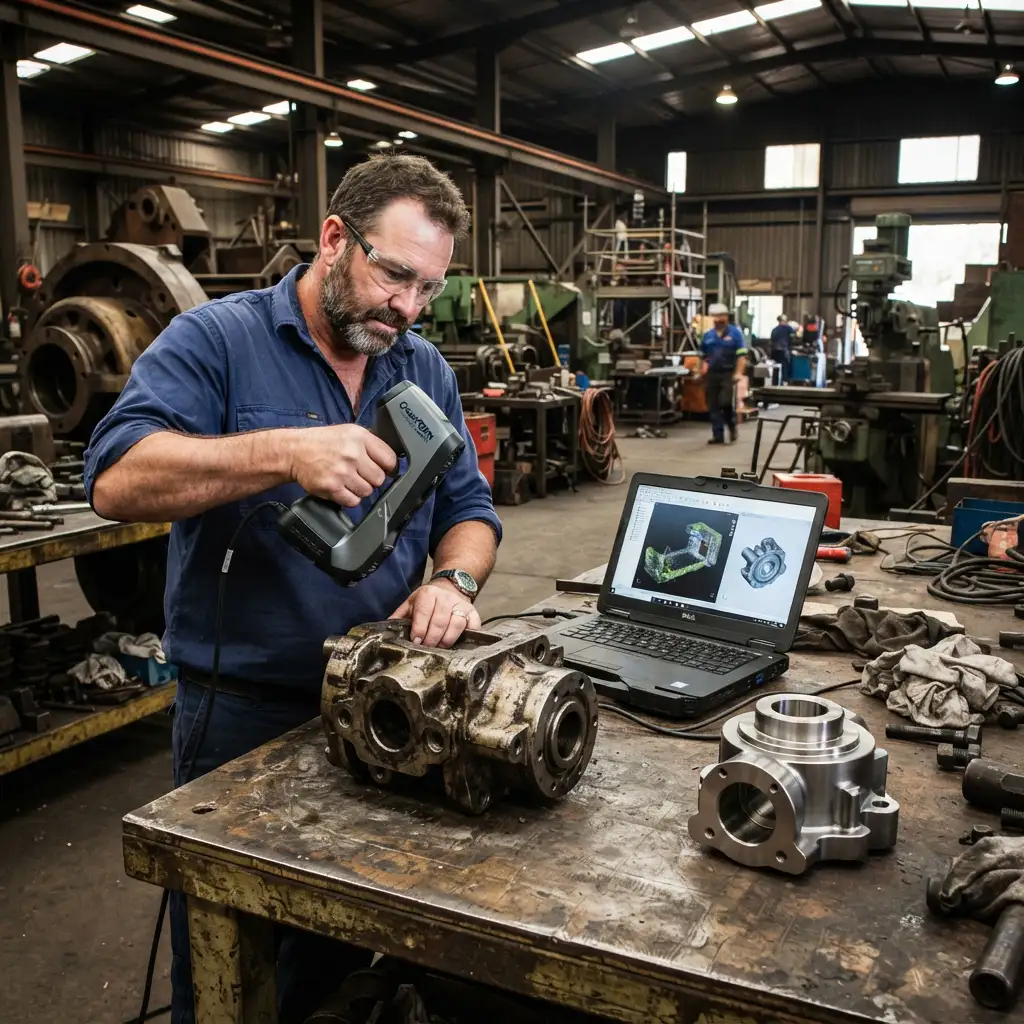
3D scanning can also support the downstream side of prototyping.
After a prototype is manufactured, scanning can capture its physical geometry and compare it with nominal CAD.
A scan-to-CAD comparison can help identify areas where manufactured geometry deviates from the design.
Depending on the component and accuracy requirements, this can complement conventional dimensional inspection.
The workflow can become:
CAD → Manufacturing → 3D Scan → CAD Comparison → Design Feedback
This closes the digital engineering loop and provides information that can be used in the next design iteration.
Reverse Engineering Existing Medical Components
Not every medical engineering project starts with new CAD.
Research organisations, equipment manufacturers and engineering teams may need to understand existing components where original digital data is unavailable.
Industrial 3D scanning and reverse engineering can convert physical geometry into editable engineering data.
The workflow typically involves:
Physical Component → 3D Scan → Mesh Data → CAD Reconstruction → Engineering Review
However, reverse engineering should not simply reproduce every physical irregularity.
Wear, deformation and manufacturing variation may need to be distinguished from intended design geometry.
This is particularly important when the reconstructed model will become the basis for a new prototype.
Prototyping Medical Equipment Components
The medical sector extends far beyond implants.
Metal additive manufacturing and engineering prototyping may also be relevant to equipment and supporting systems such as:
- specialised fixtures;
- laboratory equipment components;
- equipment brackets;
- housings;
- robotic or automation components;
- instrument-development hardware;
- customised tooling;
- and research equipment.
These applications can sometimes provide a more straightforward engineering use case than patient-contacting or implantable components because the regulatory pathway may be different.
The intended function and classification still determine the applicable requirements.
Low-Volume Development Components
Medical technology development often involves relatively low production quantities during early stages.
This is where additive manufacturing can provide practical value.
Traditional manufacturing methods can become expensive when tooling costs must be distributed across only a few parts.
Metal additive manufacturing does not eliminate setup cost, but it can reduce dependence on geometry-specific tooling.
This can make it useful for:
- one-off engineering components;
- design iterations;
- development batches;
- specialised research components;
- and selected low-volume geometries.
The economics still need to be assessed case by case.
A simple machined component may remain faster and cheaper to manufacture conventionally.
When Metal 3D Printing Is Not the Best Prototyping Process
A credible additive-manufacturing strategy also needs to identify when the technology should not be used.
Metal 3D printing may provide little advantage when:
- the geometry is simple;
- the component can be machined quickly from standard stock;
- required quantities are high enough to justify another process;
- additive surface finish creates excessive post-processing;
- tolerances require extensive secondary machining;
- the component is too large for available equipment;
- or the design does not benefit from additive manufacturing.
In these situations, CNC machining or another manufacturing process may be more appropriate.
Additive manufacturing should be selected because it solves a development or manufacturing problem—not because the component happens to be capable of being printed.
From Prototype to Production
One of the most important decisions in a prototyping programme is whether the prototype manufacturing method is intended to become the eventual production process.
There are two fundamentally different strategies.
In the first, additive manufacturing is used only to accelerate development.
The production component may eventually be machined, moulded, forged or manufactured using another process.
In the second, additive manufacturing is both the prototyping method and the intended production technology.
The second strategy allows development work to address production-relevant issues earlier, including:
- orientation;
- support strategy;
- powder removal;
- post-processing;
- dimensional compensation;
- machining;
- inspection;
- and process repeatability.
For complex metal medical components, this can reduce the gap between prototype geometry and manufacturing reality.
Medical Additive Manufacturing in Australia
Australia has a strong combination of medical research, engineering, advanced manufacturing and university capability.
For local development teams, access to metal additive manufacturing can reduce the physical distance between design, engineering review and manufacturing.
That proximity can be particularly useful during iterative development.
Instead of treating manufacturing as the final stage of product development, engineers can integrate it into the design loop.
A prototype can be produced, inspected, reviewed and modified while engineering decisions are still being made.
This is where local manufacturing capability can provide more value than simply shortening shipping time.
It can improve communication between design and manufacturing.
A Practical Medical Device Prototyping Workflow
A structured project might begin with:
1. Define the engineering question
Determine exactly what the prototype needs to demonstrate.
2. Develop or review CAD
Ensure the digital geometry reflects the intended function.
3. Select the prototype process
Choose polymer printing, metal additive manufacturing, CNC machining or another process according to the development objective.
4. Select the material
Match material choice to the level of functional representation required.
5. Apply DfAM where necessary
If metal additive manufacturing is being used, evaluate build orientation, supports and process constraints.
6. Manufacture the prototype
Produce the component under appropriate process controls.
7. Post-process
Remove supports, perform heat treatment or machining where required.
8. Inspect
Verify critical dimensions and relevant characteristics.
9. Test and evaluate
Use the physical prototype to answer the original engineering questions.
10. Feed results back into CAD
Modify the design based on measured evidence.
The process can then repeat until the design reaches the required level of maturity.
Building Better Medical Products Through Engineering Iteration
The greatest value of prototyping is not that it produces a physical object quickly.
Its value is that it creates a structured way to learn.
A well-planned prototype can reveal whether a concept fits, functions, manufactures and performs as intended.
Metal additive manufacturing expands the range of questions that can be investigated by allowing engineers to prototype complex metallic geometries directly from digital designs.
But the technology works best when integrated with engineering disciplines around it.
CAD, DfAM, material selection, simulation, post-processing, inspection and validation all contribute to the final result.
For Australian medical technology developers, the opportunity is therefore broader than simply adopting 3D printing.
It is to create a digital engineering workflow in which design and manufacturing evolve together.
Medical Engineering and Metal Additive Manufacturing at E-Metal3D
E-Metal3D supports Australian engineering projects through metal 3D printing, 3D scanning, reverse engineering and engineering solutions.
For medical product-development projects, the appropriate manufacturing route depends on the component, development stage, material, geometry and intended application.
Metal additive manufacturing can provide significant design freedom for suitable components, but it should form part of a wider engineering process rather than being treated as a standalone solution.
The objective is to select and develop a manufacturing strategy that supports the engineering requirements of the product.
What is medical device prototyping?
Medical device prototyping is the production of physical components or assemblies during product development so that engineers can evaluate geometry, fit, function, manufacturing feasibility or other design requirements before final production.
Can metal 3D printing be used for medical device prototypes?
Yes. Metal additive manufacturing can be useful for suitable prototypes requiring complex metal geometry, functional features or production-relevant materials. Suitability depends on the component and the purpose of the prototype.
What is rapid prototyping for medical devices?
Rapid prototyping refers to methods that shorten the transition from digital design to physical prototype. Additive manufacturing is commonly associated with this approach because revised CAD models can be manufactured without creating dedicated tooling for every iteration.
Which metals can be used for medical 3D printing?
Depending on the manufacturing platform, alloys can include titanium, cobalt chrome and stainless steel. Material availability does not by itself establish suitability for a particular medical device or clinical application.
Is a metal 3D-printed prototype automatically medical grade?
No. A material or manufacturing technology alone does not make a component “medical grade.” The complete manufacturing process, intended use, quality requirements, validation and applicable regulatory requirements need to be considered.
What is ISO 13485 in medical additive manufacturing?
ISO 13485 is a quality-management-system standard associated with medical devices. It should not be interpreted as automatic approval or certification of an individual additively manufactured component.
Can 3D scanning be used during medical device development?
Yes. 3D scanning can support reverse engineering, dimensional inspection and comparison of manufactured prototypes with nominal CAD geometry.
Is metal 3D printing better than CNC machining for prototypes?
Not universally. Additive manufacturing can provide advantages for complex geometry and low-volume iterations, while CNC machining may be preferable for simpler parts, tight tolerances or components that do not benefit from additive design freedom.
Can additive manufacturing be used for production as well as prototyping?
Yes, for suitable applications. If additive manufacturing is intended to become the production method, process development, quality controls, post-processing, inspection and validation should be considered during the development programme.
Does E-Metal3D manufacture finished regulated medical devices?
The appropriate scope needs to be established for each project. E-Metal3D’s relevant capabilities include metal additive manufacturing, engineering, 3D scanning and reverse engineering; a finished medical device may be subject to additional quality, regulatory and validation requirements depending on its intended use.